

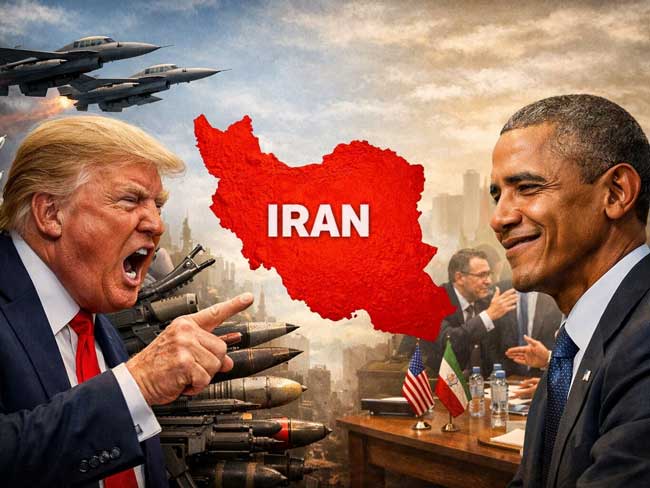
Former U.S. President Donald Trump has once again launched a strong attack on the 2015 Iran nuclear agreement, calling it a “disastrous deal” negotiated under former President Barack Obama. Trump claimed that the agreement strengthened Iran’s position in the Middle East and failed to serve American strategic interests.
Speaking on the issue, Trump reiterated his long-standing criticism of the Joint Comprehensive Plan of Action (JCPOA), arguing that the deal allowed Iran to retain pathways that could eventually lead to nuclear capability. According to him, the agreement provided financial relief to Tehran without ensuring long-term regional stability.
The JCPOA, signed in 2015 between Iran and world powers including the United States, United Kingdom, France, Russia, China, and Germany, placed significant restrictions on Iran’s nuclear program. It required Iran to reduce its enriched uranium stockpile, limit the number of centrifuges, and accept strict monitoring by international nuclear inspectors.


At the time, the International Atomic Energy Agency (IAEA) repeatedly reported that Iran was complying with the core terms of the agreement. Supporters of the deal argued that it successfully slowed Iran’s nuclear progress and reduced immediate proliferation risks in the region.
However, in 2018, the Trump administration withdrew the United States from the agreement, stating that the deal was “defective at its core” and did not address Iran’s ballistic missile program or regional activities. Following the U.S. withdrawal, Washington reimposed strict economic sanctions on Iran.
In response, Iran gradually reduced its compliance with certain commitments under the deal and expanded aspects of its nuclear activities. This led to rising tensions between Iran and Western countries, along with renewed concerns over nuclear escalation in the Middle East.
Trump, in his recent remarks, argued that had the original agreement remained in place, Iran could have moved closer to acquiring nuclear weapons capability over time. He maintained that a tougher negotiating stance is necessary to prevent such outcomes.
On the other hand, critics of the withdrawal argue that leaving the agreement contributed to increased instability and weakened diplomatic channels that had been built through years of negotiations. They also point out that the collapse of the deal has made it more difficult to restore trust between Iran and Western powers.
Efforts to revive or replace the agreement have continued intermittently in recent years, involving indirect talks and diplomatic engagement, but no comprehensive breakthrough has been achieved so far. The issue remains one of the most sensitive and unresolved topics in U.S.–Iran relations, with both sides maintaining significantly different positions on nuclear limits and sanctions relief.