
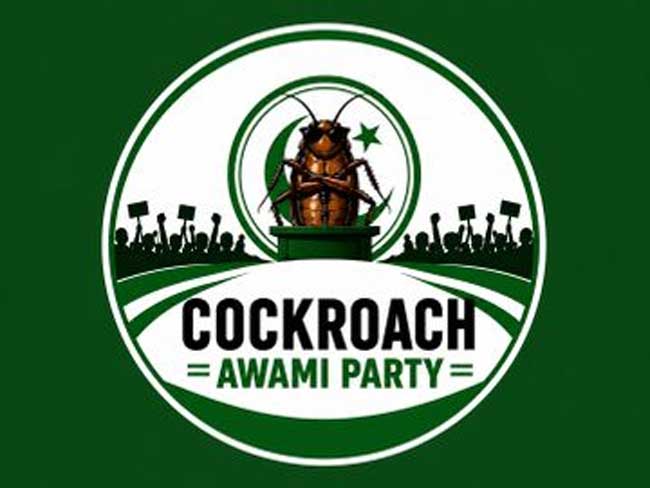
The emergence of Pakistan’s so-called “Cockroach Awami Party” may appear, at first glance, to be little more than another social media joke. Its name is unusual, its messaging is wrapped in satire, and its rise has been fueled by memes rather than mass rallies. Yet dismissing the phenomenon as mere internet entertainment would overlook a deeper reality: political satire often thrives where public frustration is searching for a voice.
Across South Asia, young people are confronting a familiar set of challenges—rising living costs, shrinking economic opportunities, growing uncertainty about the future, and a widening gap between political promises and everyday realities. In such an environment, unconventional movements frequently emerge as vehicles for expression. They may not begin as formal political organizations, but they often reflect genuine public sentiment.
The popularity of the Cockroach Awami Party is significant not because of its organizational strength, but because of what it symbolizes. The cockroach, a creature known for its ability to survive under difficult conditions, has been transformed into a metaphor for ordinary citizens struggling to navigate economic hardship, political instability, and social challenges. Whether intentional or not, the symbolism resonates with many young Pakistanis who feel overlooked by traditional political structures.


What makes this development particularly interesting is its digital-first nature. Unlike conventional political parties, which rely on established networks, public meetings, and formal leadership hierarchies, this movement has grown through social media engagement. Its language is humorous, its content is shareable, and its appeal lies in its relatability. In an age where political discourse increasingly unfolds online, such movements can gain visibility far more quickly than traditional organizations.
The trend also reflects a broader transformation in political communication. Younger generations are often less attracted to ideological slogans and more responsive to authenticity, humor, and direct engagement. Memes, satire, and viral campaigns have become tools for discussing serious issues in ways that conventional political messaging often fails to achieve. What appears frivolous on the surface may, in fact, be a sophisticated form of social commentary.
However, online popularity should not be confused with political influence. History is filled with viral movements that generated enormous attention but failed to translate that attention into meaningful change. Social media can amplify voices, but sustaining a movement requires organization, leadership, clear objectives, and the ability to engage beyond digital platforms.
The real question, therefore, is not whether the Cockroach Awami Party becomes a registered political force. The more important question is why such a movement resonates with so many people in the first place. Its popularity suggests a level of dissatisfaction that traditional political actors would be unwise to ignore. When citizens, particularly young citizens, turn to satire to express their concerns, they are often signaling that conventional channels of participation feel inadequate.
In this sense, the Cockroach Awami Party is less a political party than a political message. It reflects a generation seeking recognition, representation, and solutions to problems that continue to shape their daily lives. Whether the movement fades as a passing internet trend or evolves into something more substantial, its emergence serves as a reminder that public frustration often finds expression in unexpected forms.
And sometimes, the most revealing political commentary arrives not through speeches or manifestos, but through a viral joke that millions understand instantly.