
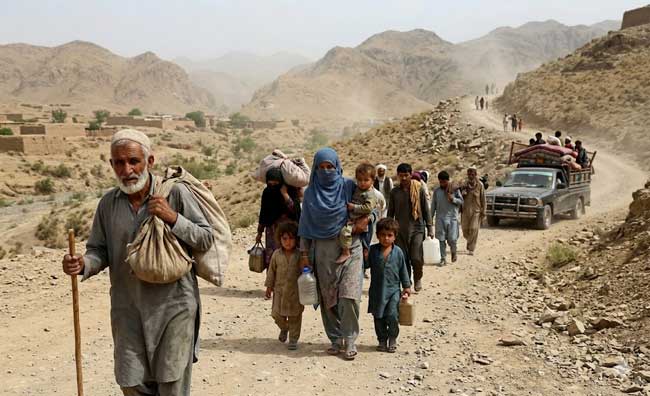
In North Waziristan’s Datta Khel tehsil, a familiar cycle of fear and flight is unfolding once again. Hundreds of families are reportedly leaving their homes amid growing apprehensions of a large-scale security operation, turning villages into corridors of hurried displacement and uncertainty. As roads tighten under restrictions and daily life grinds to a halt, entire communities find themselves suspended between the memory of past upheavals and the fear of what may come next.
Reports indicate that movement in and out of the region has been heavily curtailed for several days. Markets have shut down, essential supplies are thinning, and the rhythm of normal life has been replaced by silence and urgency. Families are leaving with whatever they can carry, often only the most basic belongings, as they attempt to reach safer areas. The scenes described by residents point to a distressing pattern: nighttime departures, overcrowded transport, and long walks under harsh conditions, all driven by the same overriding impulse—escape before escalation.
The human cost of such displacement is not abstract. Elderly residents, children, and the sick are among those most affected. Accounts from the ground describe older people struggling to walk, children experiencing trauma from abrupt evacuation, and women bearing severe emotional strain amid uncertain journeys. These are not merely logistical movements of populations; they are disruptions of life itself, where homes are abandoned without closure and futures are placed on hold indefinitely.

Local voices also reflect a deeper frustration that has accumulated over years. Traders and residents alike question why civilian populations continue to shoulder the recurring burden of operations and counter-operations. For many, the pattern feels cyclical—periods of instability followed by displacement, then fragile returns, only to face disruption again. Tribal elders, meanwhile, have reportedly expressed anger over what they see as a lack of political engagement, accusing elected representatives of remaining absent during moments of crisis.
At the heart of this situation lies a long and complex history. Communities in Waziristan have experienced repeated waves of displacement over the past two decades due to militancy and military campaigns. Each episode leaves behind more than physical destruction; it erodes trust, weakens local economies, and deepens psychological fatigue. Even when operations are framed as necessary security responses, their recurring human consequences accumulate in ways that cannot be ignored.
Government officials maintain that heightened security measures are based on intelligence inputs regarding militant presence and are necessary for broader public safety. Yet this rationale exists in tension with the lived experience of residents who associate such measures with repeated disruption, loss, and uncertainty. Over time, this gap between state security imperatives and civilian suffering has widened into mistrust—one that cannot be bridged by security operations alone.
What emerges from Datta Khel is not just a security story, but a humanitarian one. The immediate need is not only for operational clarity, but for sustained attention to displaced families, access to essential services, and mechanisms that prevent civilians from repeatedly absorbing the shock of conflict. Without addressing the human dimension, each new operation risks reinforcing a cycle in which security gains and civilian suffering are seen as inseparable—and perpetually unresolved.