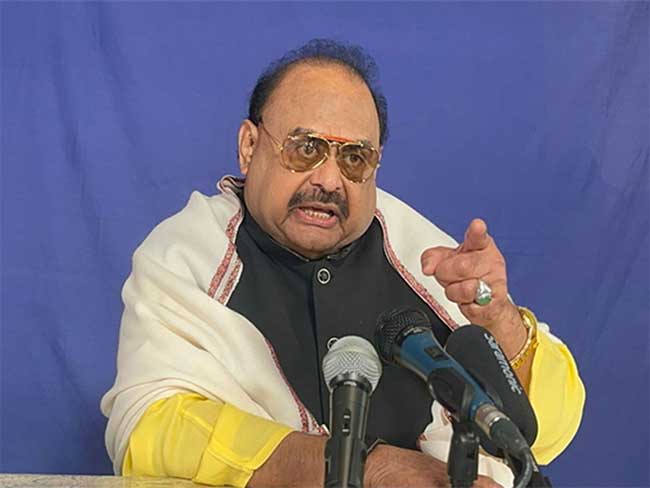
London: MQM founder and leader Altaf Hussain launched a sharp criticism of Pakistan’s military establishment, alleging systematic repression of people in Pakistan-occupied Jammu and Kashmir (PoJK) and denial of their fundamental rights.
Addressing a large gathering in London during the 48th anniversary celebrations of the All Pakistan Muttahida Students Organisation (APMSO), Hussain claimed that the people of PoJK were being met with violence rather than democratic rights.
“Instead of giving Kashmiris their rights, they are being given bullets and corpses,” Hussain said. “After witnessing such oppression, how can the people of PoJK continue to raise the slogan that ‘Kashmir will become Pakistan’?”
The MQM leader also questioned Pakistan’s long-standing Kashmir policy, alleging that successive governments and the military establishment had benefited politically and financially from the Kashmir issue while failing to address the aspirations of the people living in PoJK.
According to Hussain, residents of PoJK had supported Pakistan for decades, but were branded as “traitors” and “Indian agents” when they began demanding basic rights and accountability. He specifically referred to the Joint Awami Action Committee, claiming that the group had been targeted for raising concerns on behalf of local residents.
Drawing parallels with the Muhajir rights movement, Hussain argued that demands for constitutional and democratic rights in Pakistan were frequently met with accusations of disloyalty.
“When Muhajirs demanded their rights, they were called traitors. Today, when Kashmiris ask for their rights, they too are being labelled traitors and Indian agents,” he said.
Hussain further accused Pakistani security forces, including Rangers and police personnel, of carrying out a crackdown on peaceful protesters in PoJK, particularly in Rawalakot. He alleged that security personnel conducted raids on homes, looted businesses, opened fire on demonstrators and imposed communication restrictions, leading to civilian casualties, including children.