
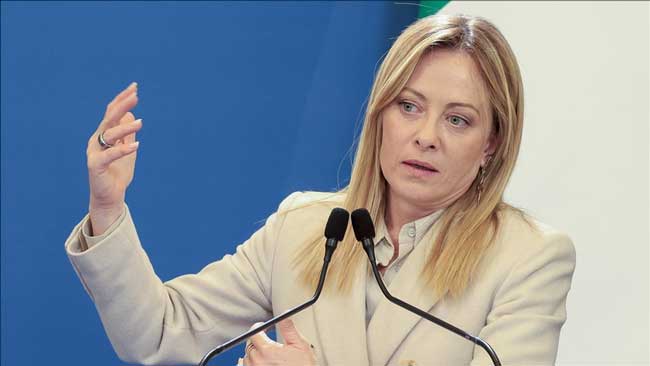
In international politics, words are never merely words. They carry messages, shape perceptions, and often influence relationships between nations. A casual remark made by a world leader can sometimes create consequences far greater than intended. The recent controversy involving U.S. President Donald Trump and Italian Prime Minister Giorgia Meloni is a striking example of how personal comments can quickly evolve into diplomatic disputes.
The controversy began with Trump’s claim that Meloni had “begged” to take a photograph with him during the G7 Summit. While such a statement might appear insignificant at first glance, its implications become far more serious when it is directed at the elected leader of a sovereign nation. In diplomacy, perceptions matter, and any suggestion that a national leader sought favor or validation from another can be interpreted as a slight against both the individual and the country they represent.
Prime Minister Meloni’s strong response reflected this reality. By categorically rejecting Trump’s assertion and describing it as false and disrespectful, she was not merely defending her personal reputation. She was defending Italy’s dignity and its standing on the international stage. Her insistence that neither she nor her country had ever pleaded for a photograph with a foreign leader resonated with many Italians who viewed the comment as an unnecessary insult.
The situation escalated further when Italian Foreign Minister Antonio Tajani canceled a planned visit to the United States. The move was widely seen as a diplomatic protest and underscored the seriousness with which Italy viewed the matter. While strategic interests often dominate foreign policy discussions, mutual respect remains an essential foundation of international relations. When that respect appears to be undermined, even symbolic gestures can carry significant political weight.
The episode also highlights a broader shift in the relationship between Trump and Meloni. Once viewed as ideological allies who shared conservative and nationalist political instincts, the two leaders have increasingly found themselves on different sides of key international issues. Diverging views on conflicts in Ukraine and the Middle East, as well as differing approaches to global diplomacy, have revealed that political affinity does not always translate into lasting strategic alignment.
Perhaps the most notable consequence of the controversy has been the unusual display of political unity within Italy. Leaders from both the governing coalition and opposition parties rallied behind Meloni, arguing that the issue transcended domestic politics and concerned national pride. Such unity is rare in modern democracies and demonstrates how questions of national dignity can often override partisan divisions.
Beyond the immediate dispute, the incident raises larger questions about the state of transatlantic relations. The United States and Europe remain close allies bound by shared economic, security, and political interests. However, recent years have exposed growing differences on several global challenges. In such an environment, personal remarks and public disputes can amplify underlying tensions and complicate diplomatic cooperation.
It is unlikely that this controversy alone will cause lasting damage to U.S.-Italy relations. The strategic partnership between the two countries is built on decades of cooperation and shared interests that extend far beyond the personalities of individual leaders. Nevertheless, the episode serves as an important reminder that diplomacy is not conducted solely through treaties, negotiations, and official statements. It is also shaped by tone, respect, and personal conduct.
In an age when every comment can instantly become a global headline, political leaders must recognize that their words carry consequences far beyond the moment in which they are spoken. What began as a remark about a photograph has become a lesson in the delicate nature of international diplomacy—where respect is not merely a courtesy but a vital component of effective statecraft.