
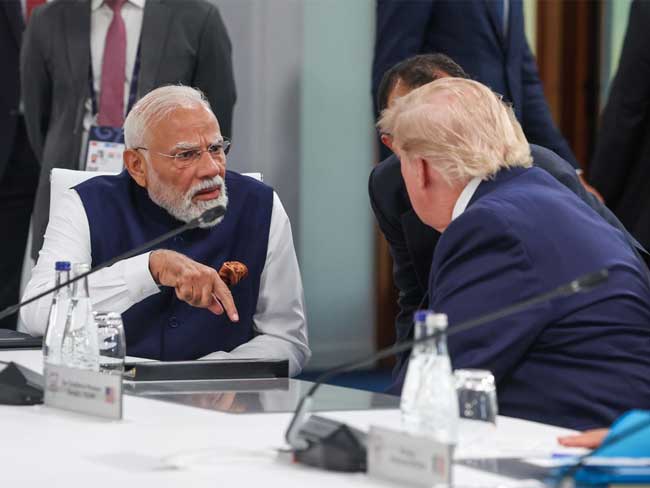
At the G7 Summit in France, Prime Minister Narendra Modi did more than speak about maritime security. Standing alongside US President Donald Trump, he delivered a pointed message to a world increasingly consumed by conflict, strategic rivalry, and eroding trust.
His observation that the world faces not only a shortage of resources but also a growing “trust deficit” was not a routine diplomatic remark. It was a sharp assessment of a global order that is struggling under the weight of wars, geopolitical tensions, and competing national interests.
By drawing attention to the security of international sea routes, Modi highlighted a reality that many world leaders often overlook. Global trade, energy supplies, and economic stability depend on safe and open maritime corridors. Yet these vital arteries are increasingly threatened by regional conflicts, attacks on commercial vessels, and political brinkmanship.

The Prime Minister’s remarks carried an unmistakable message: the world cannot expect economic prosperity while allowing instability to spread across critical maritime regions. Every disruption at sea eventually reaches factories, markets, and households around the globe.
Equally significant was his emphasis on the safety of sailors. These men and women form the backbone of international commerce, often working in dangerous waters far from their families. Modi’s concern reflected not only India’s interest in protecting its citizens but also a broader humanitarian perspective that places people at the center of global policy.
His intervention also appeared to be an indirect criticism of major powers that continue to prioritize strategic competition over collective responsibility. When nations focus solely on their own interests, trust erodes. And when trust disappears, international institutions become weaker, conflicts become harder to resolve, and global cooperation becomes little more than rhetoric.
The Prime Minister’s insistence that maritime security is a shared responsibility of all nations was therefore more than a policy statement. It was a call for accountability. No single country can secure the world’s oceans, just as no single country can guarantee global stability. Shared challenges require shared commitments.
Perhaps the strongest part of Modi’s message was his reaffirmation that dialogue and diplomacy remain the only sustainable path to peace. At a time when military confrontations dominate headlines and innocent civilians continue to pay the price of geopolitical disputes, this was a reminder that lasting solutions cannot emerge from coercion or conflict.
India’s voice at the G7 was clear and confident. Modi’s remarks underscored a growing concern that the greatest threat to the international system is not merely instability at sea or conflict on land—it is the collapse of trust between nations.
And unless that trust is rebuilt, the world risks drifting into deeper uncertainty, no matter how many summits are held or declarations are signed.