

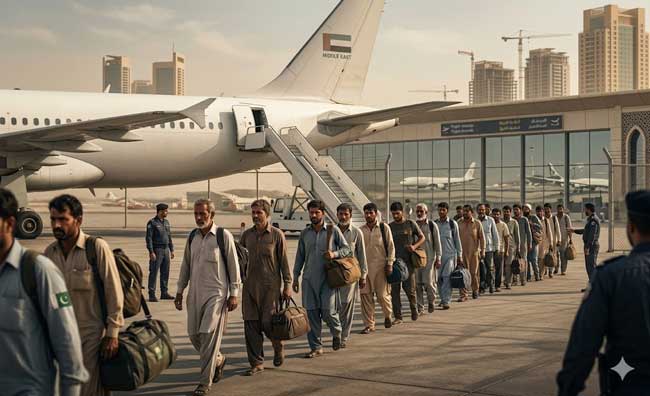
Recent media reports suggesting that the United Arab Emirates has deported thousands of Pakistani workers have sparked a wave of speculation about the deeper geopolitical signals behind the move. While neither the UAE authorities nor the Pakistani government has issued a detailed clarification, the scale and timing of these reported expulsions have inevitably drawn attention beyond the realm of routine immigration policy.
According to these reports, a significant number of Pakistani expatriates were abruptly informed of visa cancellations and directed to leave the country. Though exact figures remain unverified, estimates circulating in media and analytical circles place the number in the thousands. If accurate, such a large-scale administrative action would represent more than a routine tightening of visa compliance mechanisms.
What makes the situation particularly sensitive is the broader geopolitical backdrop in which it is unfolding. West Asia remains in a state of strategic flux, with diplomatic channels around US–Iran engagement and regional recalibrations continuing behind the scenes. In such an environment, even administrative decisions related to labour and migration are often interpreted through a geopolitical lens.


Some analysts argue that the reported deportations may reflect shifting regional calculations, where Gulf states are reassessing their diplomatic and strategic alignments amid evolving power equations. Within this interpretation, Pakistan’s perceived role or positioning in wider Middle Eastern diplomatic processes has come under scrutiny in certain commentary circles—though no official confirmation supports such claims.
At the same time, it is important to note that labour regulation and visa enforcement in Gulf countries are not uncommon and often occur as part of broader economic and administrative restructuring. The UAE, like other Gulf economies, periodically revises its workforce policies based on domestic priorities, labour market demands, and security considerations.
Nevertheless, the timing of these reports—combined with the absence of clear official explanations—has created space for speculation. For Pakistan, any large-scale reduction in overseas employment opportunities carries potential economic implications, particularly given its reliance on remittance inflows from expatriate workers in the Gulf region.
Until there is an official statement clarifying both the scope and rationale of the reported deportations, the development remains in a zone of ambiguity—sitting at the intersection of migration policy, economic dependence, and regional geopolitics.
In such situations, interpretation often moves faster than confirmation. What remains essential is separating verified administrative action from geopolitical assumption, even as the broader West Asian landscape continues to evolve.