

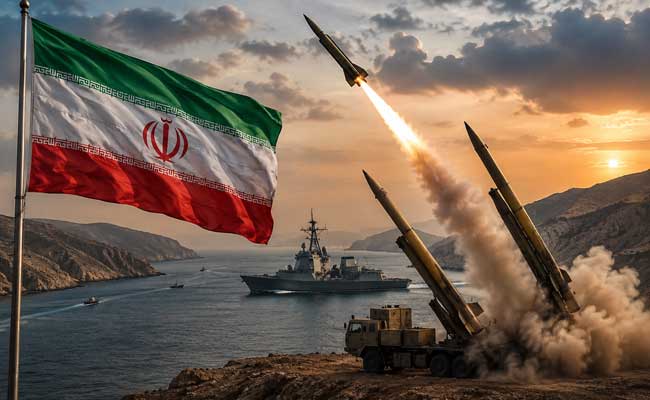
As tensions between the United States and Iran continue to escalate, Tehran’s recent assertion about its expanding military capability has added another layer of uncertainty to an already volatile geopolitical landscape. Iran’s claim that its missile stockpile has increased by nearly 120 percent, along with statements of enhanced readiness for any potential conflict, signals not just military posturing but a deliberate message of deterrence.
Iranian Foreign Minister Seyyed Abbas Araghchi, in a post on the social media platform X, emphasized that years of sanctions and sustained American pressure have failed to weaken Iran’s defense infrastructure. According to him, Iran’s missile arsenal and strategic capabilities are not only intact but expanding, suggesting a sustained effort to project resilience in the face of external constraints.
This assertion directly contradicts recent reports in sections of the American media, which suggested significant damage to Iran’s military infrastructure, including the destruction of missile launch systems. Tehran has firmly rejected these claims, dismissing them as misleading narratives aimed at distorting the reality on the ground. This information war, played out through competing narratives, reflects a broader struggle for psychological and strategic advantage between the two adversaries.


At the heart of the current tensions lies the Strait of Hormuz, a narrow but critically important maritime corridor through which nearly one-fifth of the world’s oil supply flows. Any disruption in this region has the potential to send shockwaves through global energy markets, affecting prices, supply chains, and economic stability far beyond the Middle East.
Reports of increased American military presence in the Gulf, coupled with Iran’s Revolutionary Guard Corps stating that it is closely monitoring U.S. movements, have further intensified fears of miscalculation. In such a tightly wound environment, even a minor incident could risk rapid escalation.
While diplomatic channels remain technically open, and discussions around de-escalation or temporary ceasefires are reportedly ongoing, the broader trajectory remains deeply concerning. The rhetoric on both sides, combined with military signaling, suggests a region once again standing on the edge of uncertainty.
Ultimately, the current moment underscores a familiar but dangerous pattern: where diplomacy struggles to keep pace with confrontation. Unless restraint prevails and meaningful dialogue gains traction, the Gulf risks slipping further into instability—an outcome that would reverberate far beyond its shores.