
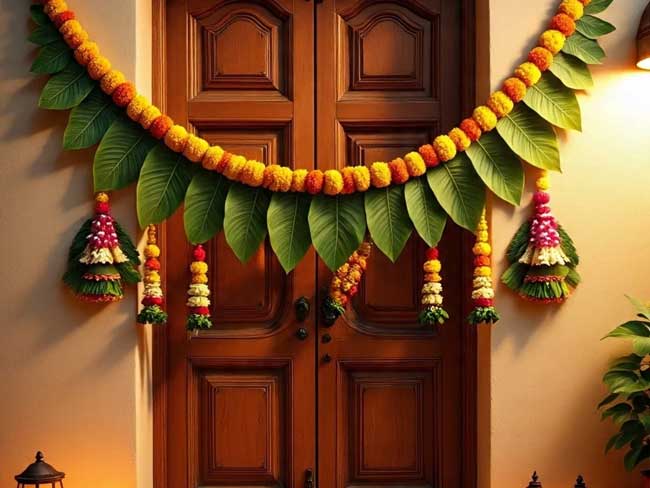
 Indian culture is deeply rooted in spiritual wisdom, where even the smallest household practices carry profound meaning. Home decoration is not merely about aesthetics; it is closely linked with energy balance, purity, and auspiciousness. Among these traditions, the mango leaf toran or bandanwar placed at the main entrance holds special significance. It is not just a decorative element but is regarded as a symbol of positive energy entering the home.
In Vastu Shastra, the main entrance of a house is considered the primary gateway for energy flow. It is believed that all external energies first enter through this point. Therefore, maintaining its purity and positivity is considered essential. The mango leaf toran is one such traditional practice that is believed to purify this entry point and welcome auspicious vibrations into the home.
The mango tree has always been regarded as sacred in Indian tradition. It symbolizes fertility, abundance, and life-giving energy. Even its leaves are considered pure and spiritually charged. When these leaves are strung together to form a toran, they are believed to create a protective and harmonious shield that filters negative energy and allows only positive vibrations to enter the house.


According to Vastu Shastra, the number of mango leaves used in a toran holds importance. They are traditionally arranged in odd numbers, as odd numbers are believed to maintain energetic balance and flow. Numbers such as five, seven, eleven, and twenty-one are considered especially auspicious. This practice is believed to enhance stability, positivity, and prosperity within the household.
The direction in which the toran is placed is also considered significant. It is generally recommended to hang it at the main entrance facing either the north or east direction. These directions are associated with light, growth, knowledge, and positive energy. When placed correctly, the toran is believed to attract harmonious and beneficial energies into the home environment.
Traditionally, mango leaf torans are not kept for long periods. It is considered ideal to replace them within seven to ten days. If the leaves begin to dry, they are usually removed promptly, as dried leaves are believed to symbolize stagnation rather than vitality. This practice reflects the principle of renewal and continuous purification.
From a spiritual perspective, the mango leaf toran is not merely an external ornament but a subtle reminder of inner discipline. It teaches the importance of regularly renewing one’s environment as well as one’s inner thoughts. Just as the leaves are replaced to maintain freshness, individuals are encouraged to let go of negativity and welcome renewed energy into their lives.
Indian traditions have always emphasized harmony between nature and human life. The mango leaf toran reflects this deep connection, where natural elements are integrated into daily living with spiritual intent. It beautifies the entrance of a home while also symbolizing purification, prosperity, and the continuous flow of positive energy.