
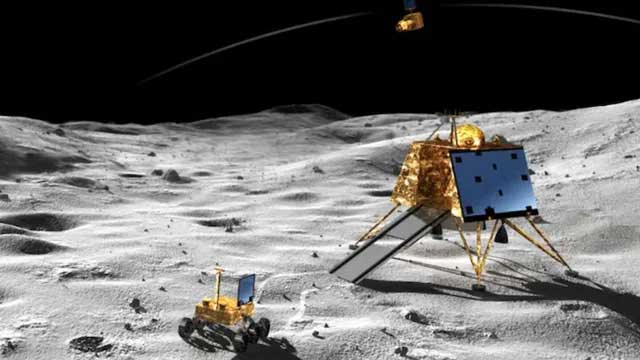
The latest analysis derived from India’s Chandrayaan-2 mission has quietly added a powerful new chapter to lunar science. Evidence pointing toward the presence of water ice in permanently shadowed regions near the Moon’s south pole is not merely a scientific curiosity—it is a potential turning point in how humanity imagines its future beyond Earth.
At the heart of this finding lies data from the Dual-Frequency Synthetic Aperture Radar (DFSAR) onboard Chandrayaan-2, jointly studied by scientists at the Indian Space Research Organisation and the Physical Research Laboratory in Ahmedabad. The radar signatures indicate anomalies in subsurface reflection patterns within deep, perpetually dark craters—signals that are consistent with the possible presence of water ice mixed with lunar soil, or regolith.
These regions, including craters such as Faustini, Haworth, and Shoemaker, exist in near-eternal darkness. Deprived of sunlight, they maintain extremely low temperatures, creating natural cold traps where volatile substances like water ice could remain stable for billions of years. It is precisely this environment that makes them among the most scientifically valuable locations on the lunar surface today.


Yet, what makes this discovery particularly compelling is not only what it suggests, but what it could enable.
If future missions confirm the presence of accessible water ice in these regions, the implications for space exploration would be profound. Water is not just a life-support resource; it is also a gateway resource. It can be split into hydrogen and oxygen, forming the basis for breathable air and rocket fuel. In practical terms, this would mean that future lunar missions may no longer need to carry all essential resources from Earth—a constraint that has long defined the economics and engineering of space travel.
This shifts the Moon from being a destination of short-term scientific visits to a potential staging ground for deeper space exploration. A sustained human presence on the lunar surface, once a speculative ambition, becomes a far more achievable objective if in-situ resources can be harnessed effectively.
However, scientific caution remains essential. Radar-based interpretations, while highly informative, are not definitive proof of ice deposits. The signals observed could also be influenced by variations in soil texture, roughness, or composition. What Chandrayaan-2 has provided, therefore, is not final confirmation but a strong and credible direction for further exploration.
Future missions—both orbital and land-based—will be required to validate these findings on the ground. Only direct sampling or high-resolution subsurface probing can establish the true nature and quantity of the suspected ice deposits.
Even so, the significance of this research should not be understated. Chandrayaan-2 continues to demonstrate how long-term value in space missions often emerges well beyond their primary objectives. While its landing attempt drew global attention, its orbital instruments are steadily reshaping scientific understanding of the Moon’s polar regions.
In a broader sense, this development also reflects a shift in India’s role in planetary exploration—from participation to leadership in specific scientific domains. By contributing to one of the most promising lines of lunar resource research, ISRO is helping define the questions that future international missions will seek to answer.
Ultimately, the idea of water on the Moon is no longer a distant hypothesis. It is becoming an active field of investigation, supported by increasingly sophisticated data. Whether or not these signals are fully confirmed as ice, they have already achieved something important: they have narrowed the unknown, and in doing so, brought the future of lunar exploration a little closer.