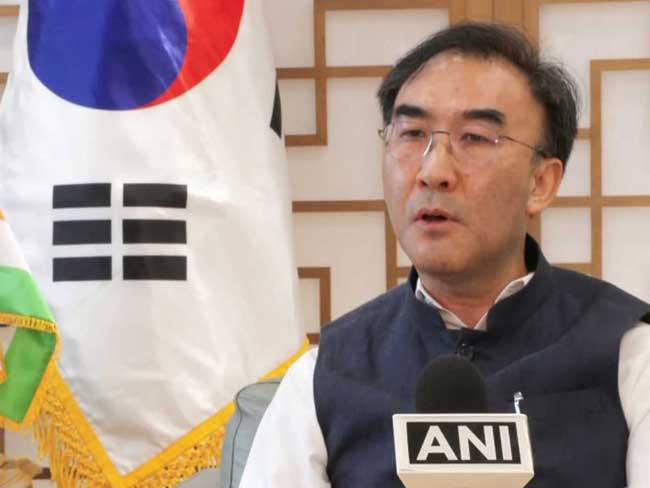
New Delhi: South Korea is increasingly focusing on artificial intelligence (AI) cooperation with India, calling it a key area of emerging collaboration as both countries aim to strengthen ties in advanced technologies, South Korean Ambassador to India Lee Seong-ho said on Monday.
In an interview, the envoy said that both sides are actively exploring deeper engagement in critical and emerging sectors such as AI, semiconductors and critical minerals, which are central to future economic and strategic growth.
“Especially, we are looking at AI collaboration more intensely. For critical minerals, India has been paying more attention to this area. We believe we have enormous potential to further explore possibilities,” Lee said.
He noted that the leadership of both countries, including External Affairs Minister S. Jaishankar and South Korean Foreign Minister Cho, have shown strong interest in expanding cooperation in these domains.
The growing partnership is anchored in the Joint Strategic Vision for the India–Republic of Korea Special Strategic Partnership, unveiled during South Korean President Lee Jae-myung’s state visit to India in April. The framework identifies AI and critical minerals as key pillars of future cooperation.
Prime Minister Narendra Modi and the South Korean leadership have also welcomed the launch of the India–Korea Digital Bridge, a new platform focused on AI, data governance and digital innovation. The initiative is expected to boost collaboration in semiconductors and other enabling technologies.
India highlighted its expanding semiconductor ecosystem and invited Korean firms to benefit from government incentives and the country’s growing market. Both sides have agreed to promote joint research, talent development and innovation under India’s “AI for All” approach and South Korea’s inclusive AI framework.
On critical minerals, the two countries have committed to building secure and resilient supply chains amid global geopolitical and resource uncertainties. Cooperation will extend across the entire value chain, including geological mapping, exploration using AI, institutional linkages between geological agencies, and recovery of minerals from e-waste and mining tailings as part of circular economy efforts.
The partnership also spans sectors closely linked to these priorities, including semiconductors, batteries, telecommunications, shipbuilding, defence manufacturing and strategic supply chains.
Describing India’s growing role in South Korea’s foreign policy outlook, Ambassador Lee said New Delhi has become central to Seoul’s economic and strategic planning.
“India’s importance in Korea’s perspective cannot be emphasised too much,” he said, adding that the two countries are poised to become “integral economic partners” if ongoing plans are implemented effectively.
He also stressed India’s significance in representing the Global South, noting that South Korea could serve as a complementary partner in this effort.
Highlighting shared strategic values, Lee said both countries support a rules-based international order amid global instability.
“Both India and Korea are like-minded countries that strongly value upholding a rules-based international order,” he said.
Calling the relationship “natural and future-oriented,” the ambassador said the absence of historical baggage between the two nations strengthens their partnership.
“Politically and historically, we don’t have any baggage between our two countries,” he noted.
He further pointed to economic complementarity, saying India offers scale, talent and a strong IT ecosystem, while South Korea contributes advanced manufacturing expertise aligned with India’s “Make in India” initiative.