

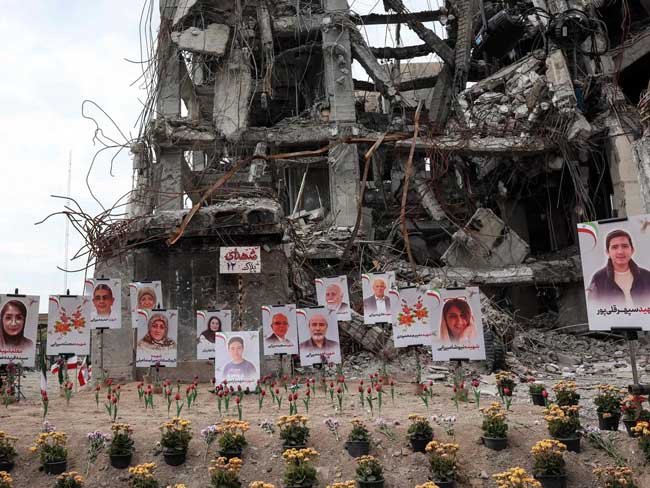
Iran today stands at a moment where numbers are no longer just statistics—they become echoes of broken streets, silence from shuttered factories, and the heavy stillness of homes that once held life and hope.
Preliminary assessments suggest that the total damage suffered by Iran has now crossed $250 billion. But this is not merely an economic figure. It is a measure of pain—slow, deep, and far-reaching—that war leaves behind.
A Fragile Economy Under Pressure
Even before the escalation, Iran’s economy was under significant strain. The conflict has now intensified that pressure, severely damaging oil and gas infrastructure, disrupting industrial production, and weakening trade networks.


Machines that once powered growth are now silent. Markets that once promised opportunity are now filled with uncertainty. The rhythm of economic life has been replaced by stagnation and fear.
A Choked Maritime Lifeline
One of the most critical global energy corridors, the Strait of Hormuz, has become a focal point of tension. Any disruption here sends shockwaves across global energy supply chains.
Oil prices fluctuate unpredictably, financial markets react nervously, and global economies brace for uncertainty. What is unfolding is not just a regional conflict—it is a disturbance in the world’s economic bloodstream.
The Real Cost of War
The harshest truth about war is that its cost is never truly borne by those who initiate it. It is carried by ordinary people.
A worker losing his livelihood, a child displaced from school into shelters, a family watching its future dissolve into uncertainty—these are the real faces behind the $250 billion loss.
Economic charts may recover over time, but human lives do not follow graphs. They carry scars that last generations.
Beyond Analysis: A Human Question
Experts warn that if the conflict continues, the losses could multiply further, and reconstruction could take decades.
But beyond economics lies a deeper question—one that no report can answer easily:
Is any objective worth the erosion of so many lives, hopes, and futures?
This is not only Iran’s story. It is a warning for every nation that views war as a solution.
War does not end problems—it begins a long chapter of suffering that seeps into societies for years.
And when losses rise beyond $250 billion, the real question is no longer how much has been destroyed—but what remains to rebuild from.