
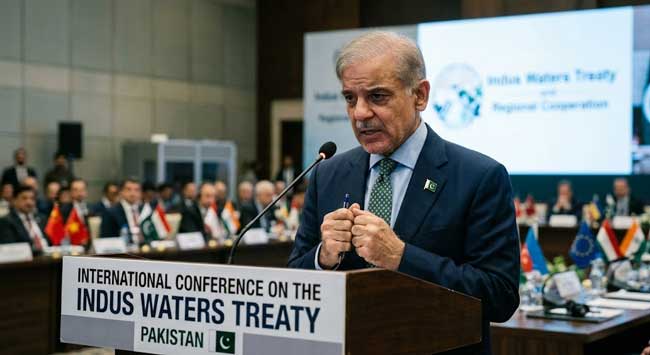
An international conference on the Indus Waters Treaty was recently held in Islamabad, bringing together experts in water management, international law, climate change, and infrastructure development. The event was presented as a platform to discuss the future of transboundary water governance in the Indus Basin, but the political undertones were difficult to miss.
Pakistan repeatedly described the Indus Waters Treaty as a “lifeline” and elevated it to the status of a national security concern, stressing that water flow under the treaty is directly linked to the country’s survival. Officials warned that any disruption in the agreed distribution of waters would be treated as a serious violation of international law.
However, what stood out in the proceedings was the careful language used when referring to upstream concerns. Even as discussions clearly revolved around tensions with India, official statements consistently avoided naming the country directly. This deliberate absence gave the messaging a cautious and restrained tone, suggesting a preference to signal concerns without explicit confrontation.


The framing of the treaty went beyond its technical origins as a bilateral agreement. Speakers repeatedly positioned it as part of a broader international legal framework governing shared rivers, arguing that transboundary water systems must not be subject to unilateral political decisions by any single state. The underlying message was clear, even if the wording remained indirect.
Several participants highlighted fears that increasing stress on the Indus Basin—driven by climate change, rising demand, and infrastructure expansion—could escalate into wider regional instability if not managed carefully. The conference thus became not just a technical dialogue, but also a platform for strategic positioning on water security.
Pakistan also signaled interest in expanding international cooperation in water storage, dam construction, and hydrological management. The emphasis was on strengthening long-term resilience, while also drawing global attention to the country’s vulnerability in the evolving water equation of South Asia.
Overall, the conference reflected a balancing act: strong warnings about water security on one hand, and noticeably restrained political articulation on the other—where even direct references to the other party remained carefully avoided, letting implication carry the weight of the message.