
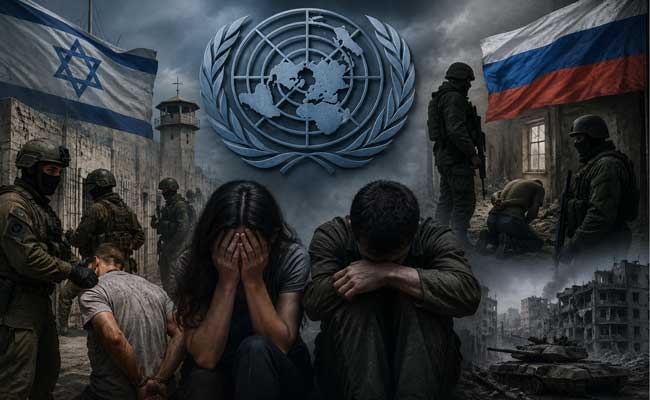
A recent United Nations report has once again raised disturbing questions about global conflict and human rights enforcement. According to the report, Russia and Israel have been included in a UN blacklist of parties “credibly suspected of committing or being responsible for patterns of rape or other forms of sexual violence” in armed conflict. The list is expected to be formally presented to the UN Security Council.
This is not merely a story about two countries or two wars. It reflects a deeper global crisis in which war is no longer confined to battlefields and weapons, but increasingly extends into the violation of human dignity itself.
Continued Allegations Despite Warnings
The report notes that UN Secretary-General António Guterres had already warned both Israel and Russia last year that they could be added to the list if documented cases of sexual violence continued. Despite this warning, the report says that such incidents continued to be documented in both the Ukraine war and the occupied Palestinian territories.

This naturally raises a difficult question: do international warnings still carry any real deterrent power, or have global institutions been reduced to documentation bodies rather than enforcement mechanisms?
Restricted Access and Investigative Limits
One of the most significant challenges highlighted in the report is the lack of access granted to UN investigators. Authorities in both contexts reportedly denied or restricted entry to detention facilities and relevant sites, limiting the ability to independently verify allegations.
This restriction exposes a structural weakness in international accountability systems—where truth-seeking is often blocked by state control over information and access. When investigations are constrained, justice becomes incomplete by design.
Findings Related to Israel
Regarding Israel, the report states that in 2025, patterns of sexual violence against Palestinians held in detention and in the occupied territories continued to be documented. These findings are described as part of a longer-term pattern, although they are not considered comprehensive due to limited access to detention centers.
The report attributes alleged responsibility to members of the Israeli military, security forces, and prison services.
Israel has strongly rejected the findings, calling them “shameful and absurd,” and accused the United Nations of equating Israel with Hamas. This sharp response highlights how deeply polarized the discourse around the conflict has become, where even allegations of human rights violations are immediately drawn into political framing.
Findings Related to Russia
In the case of Russia, the report refers to sexual violence occurring both in occupied Ukrainian territories and within Russia itself. It highlights allegations involving members of the armed forces and prison services, particularly in relation to prisoners of war.
Based on data from the UN Human Rights Monitoring Mission in Ukraine, the report documents 310 cases of conflict-related sexual violence. These include rape, genital mutilation, and electric shocks. Notably, the majority of victims were men, especially former prisoners of war who gave testimony after their release.
This underscores a less discussed reality of modern warfare: sexual violence is not limited to civilian populations alone, but is also used systematically against detainees and prisoners, often in hidden environments beyond public scrutiny.
A Broader Question for the International System
Beyond the specific allegations, the report forces a larger reflection on the effectiveness of international human rights mechanisms. In ongoing conflicts, where geopolitical interests dominate, accountability often struggles to move beyond documentation.
The issue is not only about identifying violations, but about whether global institutions can ensure meaningful investigation, enforcement, and justice when powerful states are involved.
Ultimately, the report reflects a deeper moral test for the international system—whether it can uphold human dignity consistently in times of war, or whether justice will remain uneven, conditional, and politically constrained.