

Over three weeks into the conflict in West Asia, the repercussions of the US-Iran confrontation are becoming increasingly visible. Following American and Israeli strikes, Iranian missile and drone attacks have begun to affect critical infrastructure in Gulf countries, while global oil prices continue to surge. The US, too, has suffered significant losses. Multi-billion-dollar radar systems have been targeted and destroyed, raising concerns about America’s defensive capabilities. Against this backdrop, understanding how the US monitors threats and how Iran has held its ground is crucial.
The US Military Presence and Early Warning Systems
The United States maintains a substantial military presence around Iran, with dozens of bases and thousands of troops potentially at risk. This raises a pressing question: how do soldiers get timely alerts if a missile is fired toward a US base? The answer lies in a sophisticated, multi-layered system that monitors the skies around the clock.
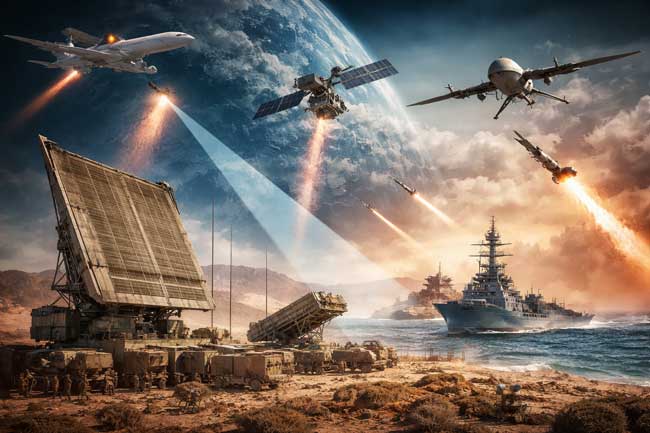
This system comprises space-based satellites, ground-based radar installations, naval vessels, and airborne surveillance aircraft. Trained personnel at the US Space Command process the incoming data and make rapid operational decisions. According to former US Air Force officers, now professors of aerospace and national security law at the University of Mississippi, these vast networks of technology and alliances are key to maintaining real-time awareness.


Spotting Missiles from Space
The fastest way to detect a missile is from space. Advanced US satellites, including space-based infrared systems, continuously monitor Earth. Considered among the most critical assets in missile defence, these multi-billion-dollar satellites can detect the intense heat generated by a missile launch almost instantaneously. The infrared sensors identify the thermal signature within seconds, triggering early warnings that are relayed to ground and naval forces, giving them precious time to respond. These alerts eventually reach joint tactical ground stations, which distribute the information across the defence network.
Tracking Missile Trajectories with Radar
Satellites provide the initial alert, but ground-based radar systems track the missile’s entire flight path. Once a missile is launched, radar installations pick up the satellite’s signals and actively monitor the projectile. By sending radio waves that bounce off the missile, the radar calculates its location and trajectory. The US deploys both long- and short-range radars: the AN/FPS-132 can monitor targets up to 4,800 km away, while the more precise AN/TPY-2 radar covers roughly 3,200 km and is often positioned near interceptors to enable immediate action.
In essence, satellites detect launches, and radar follows the missile throughout its course. However, recent Iranian strikes on radar installations in Jordan and Qatar have highlighted vulnerabilities. These systems are expensive and not easily replaceable. To bolster defences, the US temporarily redeployed a TPY-2 radar from South Korea to West Asia. While this move strained US surveillance coverage, it did not eliminate it entirely. Additional systems, including those in the UK, continue to provide support. US Navy ships, equipped with Aegis Combat Systems (AN/SPY-1 radar), can monitor up to 322 km and position themselves near threat zones as needed.
Why Iranian Drones Are Harder to Counter
While missiles generate intense heat and are relatively easier to detect, Iranian drones present a more complex challenge. Systems like the Shahid drone produce minimal heat, making them difficult for infrared sensors to track. Many drones are small, fly close to the ground, and are constructed from materials like plastic or fiber that reduce radar visibility. Some drones navigate via GPS without emitting radio signals, further complicating detection and interception efforts.
The evolving conflict underscores the growing sophistication of Iranian tactics and the limits of even the most advanced US defence networks. As the war enters its fourth week, both sides continue to adapt in a high-stakes contest of technology and strategy.