

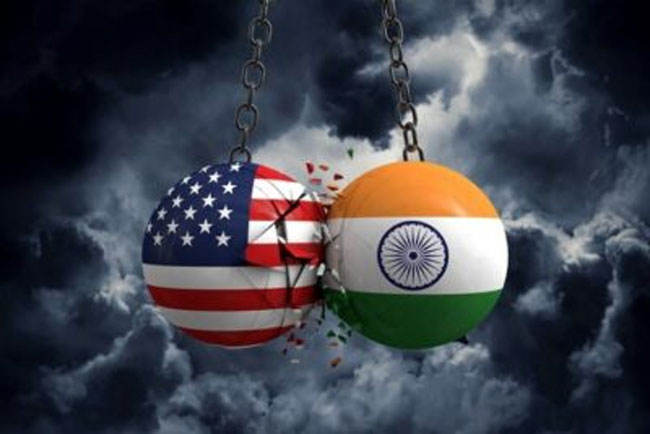
U.S. President Donald Trump has introduced a 25% import tariff and a further penalty on Indian items beginning August 1. This transfer is anticipated to make Indian exports to the U.S. considerably costlier, doubtlessly impacting India’s export-driven sectors.
Notably, Trump had earlier declared a 26% tariff on Indian imports on April 2 this 12 months, however that call was postponed till July 9 and later prolonged till August 1. Now, the imposition of the 25% tariff and the extra penalty has formally been confirmed.
Affect on Indian Exports
With these new tariffs, exporting Indian items and companies to the U.S. will turn out to be dearer, probably resulting in a pointy decline in demand throughout the American market. Initially, each nations had set a goal to finalize the primary part of a commerce settlement by September–October, aiming to double bilateral commerce to $500 billion by 2030. Nonetheless, negotiations have since hit a number of roadblocks.


Modi-Trump Assembly and Commerce Talks
Throughout President Trump’s go to to the U.S. in February this 12 months, he and Prime Minister Narendra Modi agreed to work in the direction of a bilateral commerce deal. Since then, 5 rounds of negotiations have been held, with the most recent happening in Washington. Nonetheless, no breakthrough was achieved. The sixth spherical is scheduled for August 25 in India.
Key Sticking Factors
Based on sources, each side have failed to achieve consensus on a number of points. The U.S. is especially eager to have better market entry for its dairy and agricultural merchandise in India at aggressive charges. It desires India to supply tariff concessions underneath the Bilateral Commerce Settlement (BTA), which New Delhi is reluctant to do, fearing antagonistic impacts on its home industries, particularly farmers.
What India Desires
India, then again, is pushing for tariff aid on labor-intensive sectors equivalent to textiles, gems and jewellery, leather-based items, attire, plastics, chemical substances, shrimp, oilseeds, grapes, and bananas. New Delhi additionally desires the removing of the 26% further obligation imposed on its exports and seeks a discount in tariffs on metal and aluminum (at the moment at 50%) and automotive merchandise (25%).
America’s Calls for
Beneath the BTA, the U.S. desires India to cut back tariffs on sure industrial items, vehicles—particularly electrical autos—wine, petrochemical merchandise, agricultural items, dairy merchandise, apples, and genetically modified crops. Nonetheless, India has refused to decrease tariffs on sure agricultural and dairy merchandise because of stress from farmer teams that concern such concessions would damage the home agriculture sector.
“U.S. Desires Offers on Its Personal Phrases” – Professional Opinion
Professor Arun Kumar, former professor at Jawaharlal Nehru College, believes that the Trump administration has introduced a wave of uncertainty to the worldwide market. Based on him, the U.S. seeks to barter commerce offers by itself phrases and makes use of tariff impositions and monetary penalties as instruments to stress different nations.
He provides that one other underlying cause for the tariffs is India’s continued import of crude oil from Russia—one thing the U.S. disapproves of amid the continued Russia-Ukraine battle. The American administration, aiming to isolate Russia economically, could also be utilizing these tariffs as leverage to pressure India to chop vitality ties with Moscow.