
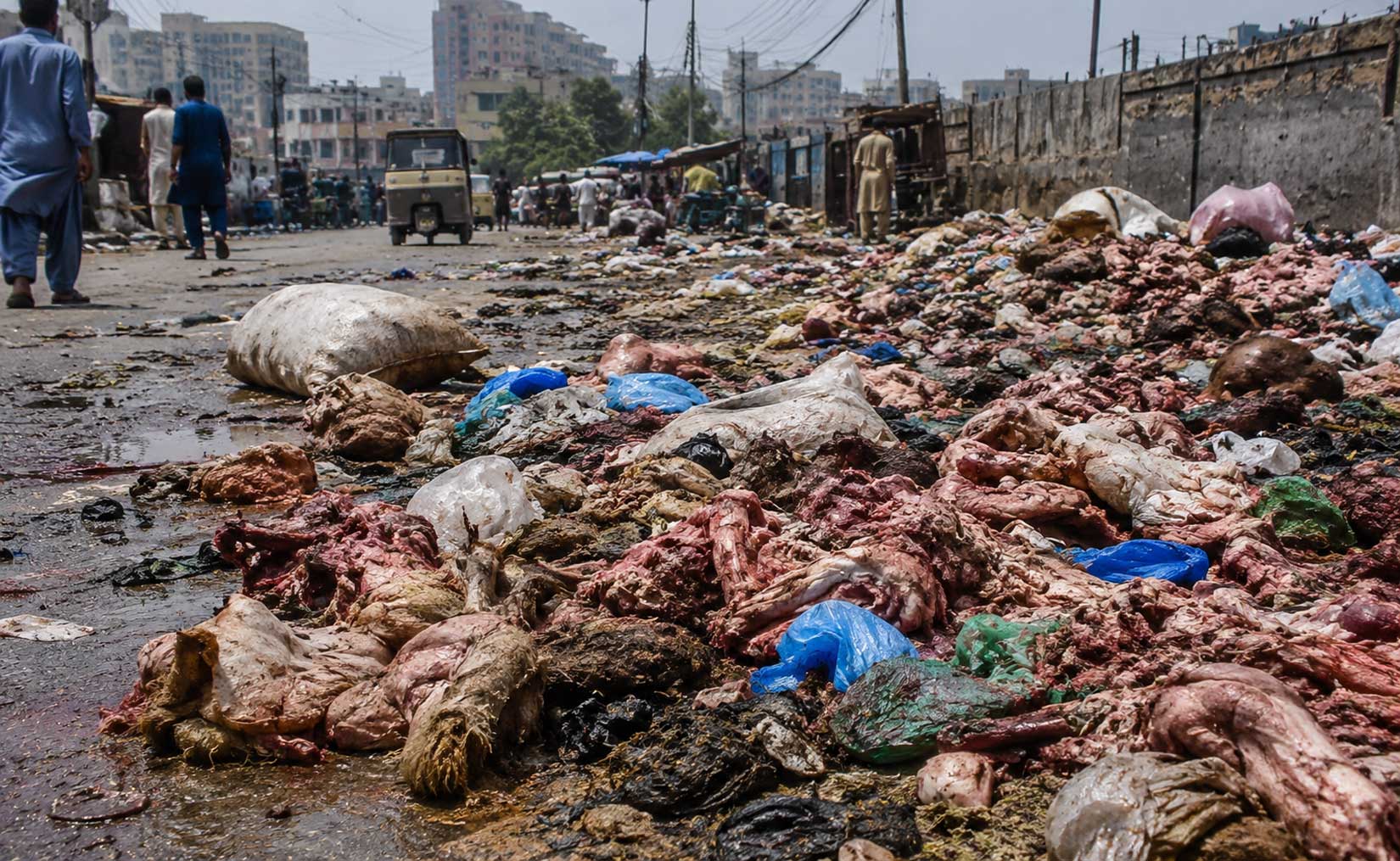
After Eid-ul-Adha, a disturbing picture has emerged from Pakistan’s largest city, Karachi, raising serious questions about urban governance and public sanitation. Streets filled with waste, accumulated animal remains, and unbearable stench in extreme heat have significantly disrupted daily life. What is being witnessed is not just a temporary lapse in cleanliness, but a reflection of deeper administrative weaknesses.
In Karachi, during the three days of Eid-ul-Adha, a large number of animal sacrifices were carried out. Following this, streets, alleys, and open spaces were reportedly covered with animal waste and remains. According to figures released by the Sindh Solid Waste Management Board, more than 142,000 tons of animal waste were collected, including over 64,000 tons of animal parts alone. While these are official estimates, local conditions are believed to be even worse than reported.
Extreme heat and humidity have worsened the situation further. As remains left in the open began to decompose, a strong foul smell spread across several neighborhoods, making it difficult for residents to step outside their homes. This is no longer merely a sanitation challenge but also highlights gaps in urban planning and emergency waste management systems.


In Pakistan, Karachi has repeatedly faced such post-festival sanitation crises. The city already struggles with waste disposal, drainage, and civic infrastructure issues, and the aftermath of Eid has once again exposed these long-standing weaknesses in an intensified form.
The Sindh Solid Waste Management Board claimed to have launched a cleanup operation over the three-day period. However, several residential areas still report the presence of waste and foul odors. This gap between official claims and ground reality highlights the disconnect between administrative messaging and lived experiences of citizens.
The situation has also triggered political controversy. Leadership from Jamaat-e-Islami criticized the provincial administration, accusing it of corruption and inefficiency. They argued that despite a substantial budget allocation, sanitation efforts remained inadequate, forcing residents to bear the burden themselves.
On the other hand, Karachi Mayor Murtaza Wahab defended the municipal response, stating that he personally monitored cleanliness operations across different parts of the city. He maintained that municipal teams remained active and that cleanup operations continued until animal remains were fully removed from the streets.
Between these competing narratives lies a more complex reality. While authorities claim active intervention and progress, residents continue to struggle with persistent waste and unbearable conditions. This contradiction reflects not only a post-festival crisis but also deeper structural limitations in urban governance.
In a megacity like Karachi, where basic sanitation itself becomes a challenge during peak pressure periods, the key question is whether the issue lies in lack of resources or in their ineffective management. The post-Eid situation thus becomes more than a seasonal inconvenience—it stands as a broader commentary on accountability, planning, and institutional efficiency in urban administration.