
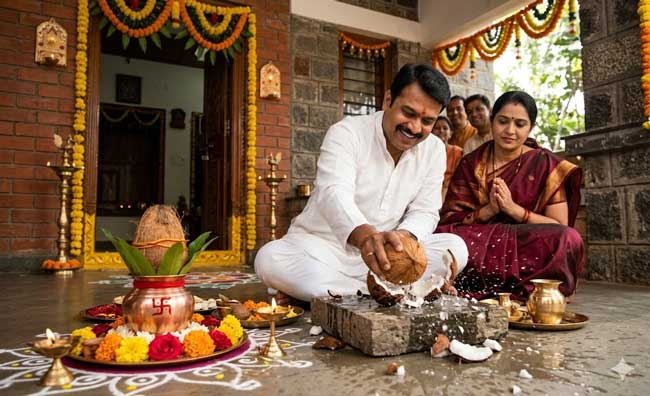
In Sanatan (ancient Hindu) culture, every auspicious beginning is not merely a ritual act but a deeply spiritual  expression. Whether it is a housewarming ceremony, the start of a new business, a wedding ritual, or the initiation of any religious observance, the tradition of breaking a coconut is seen almost everywhere. This practice is not limited to religious faith alone; it also carries profound philosophical and spiritual meaning.
In Hinduism, the coconut is referred to as “Shrifal.” The term “Shri” is associated with Goddess Lakshmi, symbolizing prosperity and abundance, while “phal” signifies offering and virtue. This is why the coconut is considered one of the most sacred offerings presented to deities. Its hard outer shell and pure white inner flesh are often seen as symbolic of human life itself.
According to religious scholars, the hard outer covering of the coconut represents human ego, anger, and worldly impurities. When a person breaks a coconut before the divine, it symbolizes the surrender of ego and the complete offering of oneself in devotion to God. The pure water and white kernel inside are considered symbols of spiritual purity and innocence.


In Sanatan tradition, it is also widely believed that any auspicious activity must begin with the worship of Lord Ganesha, the remover of obstacles. The coconut is regarded as one of Lord Ganesha’s favorite offerings. Therefore, offering a coconut during worship is seen as an indication of prosperity, success, and the removal of obstacles. Devotees believe that breaking a coconut helps dispel negative energies and clears hurdles in the path of any undertaking.
According to mythological beliefs, the coconut is also considered a symbol of the Holy Trinity—Brahma, Vishnu, and Mahesh (Shiva). Some legends even suggest that when Lord Vishnu descended to Earth, he brought the coconut tree along with him, which is why it is regarded as a divine symbol of prosperity and sanctity.
From a spiritual perspective, breaking a coconut is not just a ritual tradition but a lesson in humility for human beings. It reminds us that true success in life depends not on external display but on inner purity and surrender. When a person begins any task with devotion, humility, and a positive mindset, they become truly worthy of auspiciousness.
Even in the modern era, this tradition continues to be observed with the same faith and reverence. From temples to new business ventures, the practice of breaking a coconut reflects the deep spiritual consciousness of Indian life philosophy, where every auspicious beginning is connected with remembrance of the divine and self-surrender.