
Recent political developments across several countries have once again intensified discussions around the concept of the “deep state.” From Latin America to the Middle East and South Asia, a series of dramatic power shifts and political upheavals have raised questions about external influence, regime change, and the role of unseen forces in shaping national destinies.
In Venezuela, the United States is widely perceived to exercise decisive influence. Control over Venezuelan oil production is believed to be largely aligned with U.S. interests, while President Nicolás Maduro faces legal proceedings in American courts. Reports and speculation suggest that Washington may support the installation of a more compliant leadership in Caracas in the near future.
Simultaneously, Iran is witnessing sustained protests against the rule of Supreme Leader Ayatollah Ali Khamenei. Amid these movements, the name of Reza Pahlavi—son of Iran’s last monarch and an exiled crown prince—has resurfaced prominently. Given Pahlavi’s longstanding proximity to the United States, analysts have begun to frame the Iranian unrest within the broader narrative of deep-state intervention.

Syria, once a focal point of prolonged conflict, has seen a dramatic political transition, with its current leadership reportedly moving toward improved relations with Washington. In South Asia, Bangladesh is undergoing its own political transformation. Former Prime Minister Sheikh Hasina is presently in exile, while Nobel laureate Muhammad Yunus has assumed leadership in an interim capacity.
Taken together, these developments have rekindled debate around whether a coordinated pattern exists—one driven not merely by internal dissent but by external orchestration.
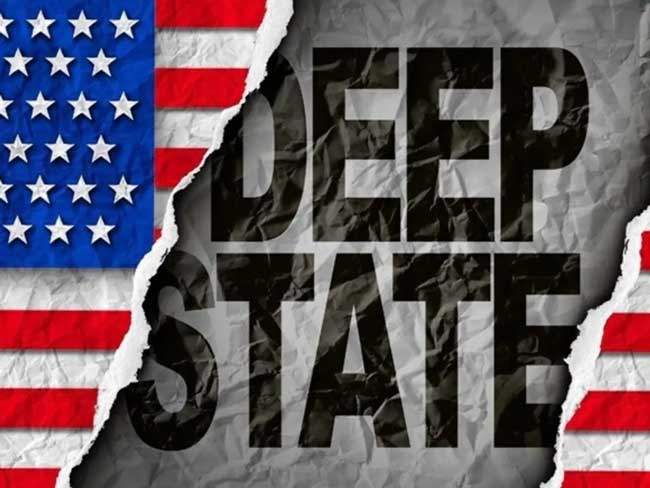
What Is the Deep State?
The term “deep state” refers to a situation in which a country’s formal governance structure is undermined or influenced by hidden networks—often involving foreign powers or domestically embedded actors aligned with external interests. These networks may operate within intelligence agencies, military establishments, bureaucratic systems, or political institutions.
Broadly, the concept suggests that regime change can be engineered not through direct military intervention, but through sustained political pressure, narrative shaping, and institutional manipulation. The term itself implies deep, entrenched roots that operate beyond democratic accountability.
The idea of the deep state is most frequently associated with the United States, which is often accused by critics of attempting to reshape governments worldwide to better align with its strategic and economic interests.
How Narratives Are Reshaped
Stephen Kinzer’s book Overthrow: America’s Century of Regime Change from Hawaii to Iraq offers a detailed historical account of such interventions. According to this framework, think tanks, non-governmental organizations, and sections of ideologically aligned media play a critical role in reshaping public narratives within target countries.
These narratives often emphasize themes such as the erosion of free speech, the rise of authoritarianism, religious extremism, or systemic corruption. Over time, such messaging can alter public perception, mobilize popular discontent, and eventually culminate in mass movements or political collapse.
A recent example frequently cited is Pakistan. Following his removal from office, former Prime Minister Imran Khan alleged that his government was toppled through a coordinated effort involving opposition parties, the military establishment, and indirect U.S. influence. Subsequent displays of closeness between Pakistan’s current army chief, General Asim Munir, and Washington have further fueled such suspicions among Khan’s supporters.
A Pattern or Perception?
Whether these developments represent a deliberate strategy or a convergence of internal crises remains a subject of intense debate. However, the recurrence of similar political trajectories across multiple regions has ensured that the concept of the deep state remains central to contemporary geopolitical discourse.
What is clear is that in an interconnected world, power is no longer exercised solely through visible means. Influence increasingly flows through narratives, institutions, and alliances—often operating well below the surface of formal politics.