
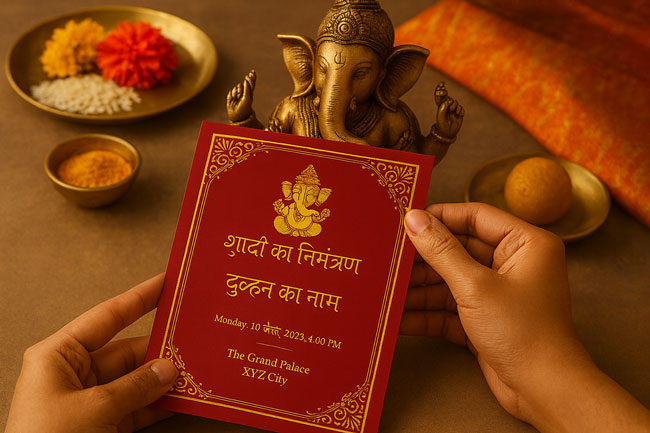
A wedding ceremony within the household—whether or not of a son or daughter—is a second of pleasure, celebration, and sacred rituals. Amid all of the preparations, there are specific traditions related to wedding  ceremony invitation playing cards that many households think about auspicious.
Making ready the Invitation Playing cards
As soon as the marriage playing cards arrive from the printer, it’s customary to put aside 5 playing cards. Making use of a contact of turmeric (haldi) to those playing cards can also be thought-about an indication of fine fortune and is believed to reinforce the auspiciousness of the occasion.
Earlier than beginning the distribution, providing prayers to Lord Ganesha is very really useful. As per Vastu Shastra, maintaining the freshly printed playing cards within the northeast course is taken into account auspicious, since this course is believed to be the abode of divine energies.


On the subject of colours, crimson, yellow, inexperienced, and golden are historically most well-liked for wedding ceremony playing cards. Additionally, the dates and timings of every ceremony should be clearly and precisely talked about.
Who Ought to Obtain the First Marriage ceremony Invitation?
In Indian custom, the distribution of wedding ceremony invites follows a significant sequence to make sure blessings and concord within the marriage.
- First Invitation — Lord Ganesha
To hunt His blessings for a clean and obstacle-free wedding ceremony. - Second Invitation — Lord Vishnu and Goddess Lakshmi
To invoke prosperity, concord, and success for the couple. - Third Invitation — Lord Hanuman
To guard the household and the ceremony from unfavorable influences. - Fourth Invitation — The Household Deity (Kuldevi/Kuldevta)
To honor ancestral traditions and search divine safety. - Fifth Invitation — The Ancestors (Pitru)
A card is positioned below the Peepal tree together with a small providing of sweets, symbolically inviting the ancestors to bless the marriage.
Inviting Kinfolk: The Order
After providing invites to deities and ancestors, the following step is to ask relations.
- The primary invites are historically despatched to the maternal household (mama) and the paternal aunt (bua) or daughters of the home.
- In the course of the conventional bhat/nyota go to, the sister can also be given the marriage card.
- After this, all elders and shut relations of the household are invited.
These customs aren’t merely rituals; they signify a heartfelt want to hunt blessings from each divine and familial sources for a affluent and harmonious wedding ceremony.