
A border is not merely a line on a map—it is the pulse of a nation. And when that pulse is under pressure from irregularities, the response is not just administrative, but fundamentally existential.
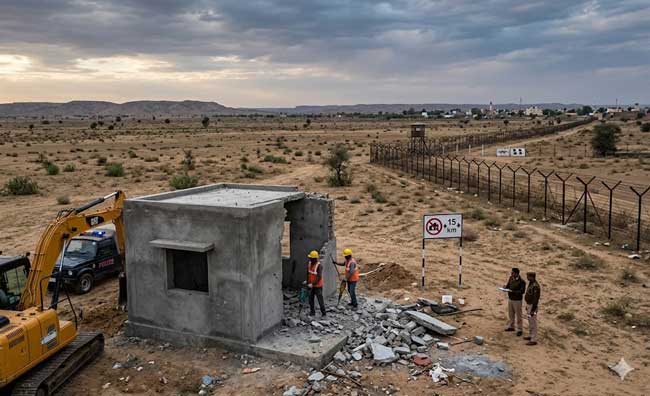
The recent high-level security review meeting in Bikaner, followed by directives from Union Home Minister Amit Shah, reflects this very urgency. The order to identify and demolish all illegal constructions within a 15-kilometre radius of India’s international borders signals a firm and uncompromising stance: in border regions, unauthorized structures will no longer be treated as isolated local issues, but as matters directly tied to national security.
This approach is not sudden. For years, security agencies have flagged concerns over illegal constructions, encroachments based on fraudulent documentation, cross-border smuggling networks, and suspicious financial activities in border districts. These are not merely violations of land or municipal laws; they often form the physical and administrative cover for deeper networks involving infiltration, intelligence gathering, and illicit economic systems.


The directive emphasizes a “zero tolerance” policy, but more importantly, it underlines a structural shift in how border security is perceived. Security is no longer framed solely as the responsibility of the armed forces. Instead, it is presented as a coordinated ecosystem involving local administration, intelligence agencies, financial regulators, and surveillance institutions working in tandem.
Reports reviewed in the meeting also highlight growing concerns over fake identities, illegal bank accounts, and unregulated commercial activity in sensitive border belts. These developments point toward the emergence of parallel systems that operate beneath the surface of formal governance. The instruction to dismantle such networks reflects an effort to close these gaps before they evolve into deeper vulnerabilities.
The push for strict monitoring of banking transactions and commercial entities in border districts adds another layer to this strategy. It indicates that modern border security is no longer confined to physical surveillance alone. It now extends into financial intelligence, digital tracking, and data-driven monitoring of suspicious patterns.
At its core, the policy direction is about tightening the entire chain of oversight—from land use and construction to financial flows and identity verification. Illegal structures, in this context, are not just physical encroachments; they are indicators of systemic weaknesses that can be exploited if left unchecked.
However, the challenge lies not only in issuing directives but in their sustained implementation. Many of these illegal constructions have developed over years, often embedded within local socio-political and economic ecosystems. Their removal will require not just enforcement power, but administrative consistency and inter-agency coordination over time.
Ultimately, the move signals a recalibration of border governance. It reflects an understanding that national security is not only defended at the frontier by uniformed forces, but also shaped in villages, banks, administrative offices, and construction sites that lie close to it.