
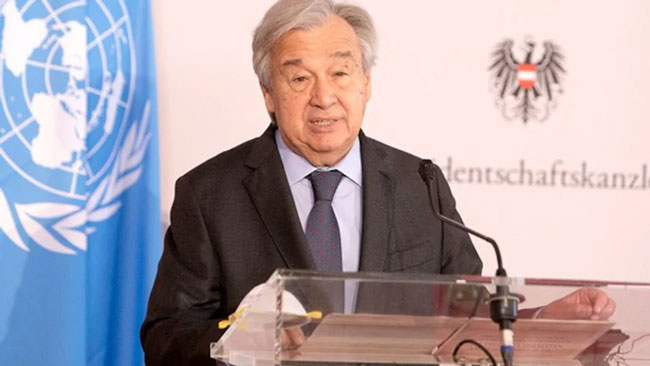
Geneva: United Nations Secretary-General António Guterres has called on all parties involved in the escalating West Asia crisis to pursue urgent diplomatic solutions, warning that continued hostilities risk pushing the region into a broader conflict.
In a post on X, Guterres said the Middle East is being “pulled deeper into crisis,” adding that the consequences extend far beyond the region. He cautioned that recent developments have further deteriorated an already fragile situation, stating that what remains of the ceasefire is “more like a lesser-fire” and warning that it must not be allowed to turn into a full-scale conflict. He urged all sides to halt attacks and avoid further escalation, stressing that only a diplomatic settlement can stabilize the situation.
Meanwhile, tensions continue to rise across the West Asia and Gulf regions, with Kuwait, Jordan, and Bahrain issuing alerts after air defence systems reportedly intercepted unidentified aerial targets.

The developments come in the aftermath of the United States Central Command (CENTCOM) announcing that it had conducted additional “self-defence strikes” on June 10, targeting multiple sites in Iran. According to CENTCOM, the strikes were directed at Iranian military surveillance infrastructure, communication networks, and air defence systems, following directives from the U.S. leadership.
In response, Iranian officials reportedly announced the closure of the Strait of Hormuz, a critical global oil shipping route. However, CENTCOM later issued a clarification stating that commercial shipping continues to move normally through the strait.
Further escalation was reported through Iranian state-linked media, with IRGC sources claiming that 18 U.S.-related military sites were targeted in retaliation. These reportedly included the Ali Al-Salem Air Base and Ahmed Al-Jaber Air Base in Kuwait, as well as Sheikh Isa Air Base in Bahrain.
As the situation intensifies, Iran’s Press TV quoted Islamic Revolutionary Guard Corps (IRGC) Commander General Sayed Majid Mousavi as warning the United States, stating that continued threats to the security of the Strait of Hormuz could turn the region into “hell.”