

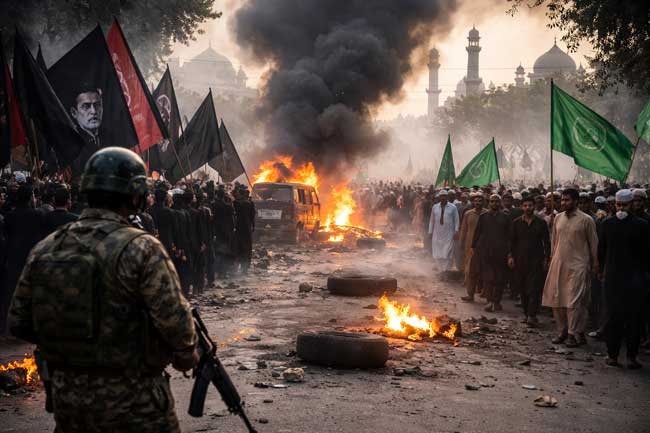
Pakistan appears to be walking a dangerous tightrope as the ripple effects of the escalating crisis in Iran begin to stir unrest within its own borders. What initially seemed like a distant geopolitical conflict is now threatening to inflame long-standing sectarian fault lines in the country.
In recent days, protests by sections of the Shia community have been reported across multiple regions of Pakistan. These demonstrations, triggered by developments in Iran, have in some cases turned violent, leading to clashes with security forces and raising serious concerns about internal stability. The situation underscores how deeply interconnected regional politics and domestic fault lines have become.
Amid growing tensions, Pakistan’s Army Chief, General Asim Munir, convened a crucial meeting with Shia clerics in Rawalpindi. During the interaction, he reportedly emphasized that Pakistan cannot allow foreign conflicts to ignite violence within its territory. He urged religious leaders to play a constructive role in maintaining peace and discouraging sectarian narratives.


However, the meeting has also stirred controversy. Reports suggest that certain remarks attributed to the army chief were perceived as insensitive by parts of the Shia community, further intensifying unease rather than calming it. This highlights the fragile nature of the current situation, where even attempts at de-escalation risk being misinterpreted.
The broader concern lies in Pakistan’s delicate sectarian balance. While the country is predominantly Sunni, it is also home to a significant Shia population with religious and emotional ties to Iran. At the same time, Pakistan’s strategic and political alignment with countries like Saudi Arabia adds another layer of complexity. The ongoing Iran-related developments have brought this duality into sharp focus.
Historically, Pakistan has struggled with sectarian tensions, particularly since the aftermath of the 1979 Iranian Revolution. Over the decades, sporadic outbreaks of violence have exposed the deep-rooted nature of the divide. The current situation, however, carries an added risk: it is being fueled not just by internal dynamics, but by a rapidly evolving regional crisis.
Security analysts warn that if not managed carefully, the present unrest could evolve into a broader sectarian confrontation. The convergence of external geopolitical pressures and internal vulnerabilities makes this moment particularly critical for Pakistan’s leadership.
Conclusion:
Pakistan now faces a pressing challenge—containing the spillover of an international conflict while safeguarding its internal cohesion. Whether it succeeds will depend not only on state action but also on the ability of religious and community leaders to prevent divisions from deepening further.