
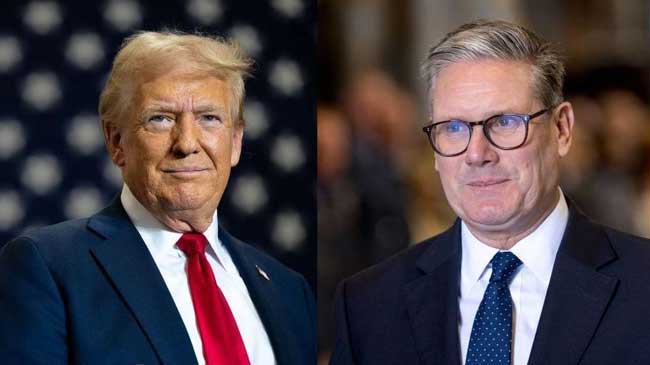
Former United States President Donald Trump’s recent claim that British Prime Minister Keir Starmer could resign has injected a fresh layer of transatlantic drama into an already tense political atmosphere in the United Kingdom. The remark, made on Trump’s social media platform, was characteristically blunt and critical, alleging that Starmer is facing severe political difficulties and “failed badly” in key governance areas such as immigration and energy policy.
At first glance, the statement appears to be another instance of Trump’s well-known tendency to comment forcefully on foreign political affairs. However, the timing of the remark has ensured that it has not been dismissed outright as mere political rhetoric. It arrives at a moment when Starmer’s leadership is indeed being tested by internal party pressures and fluctuating public confidence.
Within the United Kingdom, Prime Minister Keir Starmer continues to face scrutiny over policy direction and political positioning, particularly as the Labour Party balances governance expectations with internal ideological diversity. Reports of behind-the-scenes discussions within party circles suggest a degree of restlessness, although no formal leadership challenge has emerged.

On the other side of the Atlantic, former President Donald Trump has once again demonstrated his willingness to intervene rhetorically in the domestic politics of allied nations. His comments, while influential in media cycles, do not reflect any institutional authority or verified diplomatic assessment. Instead, they function primarily as political commentary shaped by his broader critique of liberal governance models in Europe.
The British government, for its part, has offered no indication that a resignation is being considered. Downing Street’s position remains that Starmer continues to serve as Prime Minister with full authority, and that leadership speculation is not grounded in any formal political process. In the United Kingdom’s parliamentary system, leadership change within a governing party follows structured internal mechanisms rather than external commentary or informal pressure.
What makes this episode noteworthy is not the substance of Trump’s claim, but its amplification across international media ecosystems. In an era where political narratives travel instantly across borders, even speculative remarks can influence perceptions of stability. This is particularly true when they concern leaders already navigating domestic political headwinds.
At the same time, analysts caution against conflating political criticism with political inevitability. While every government faces internal disagreement and external scrutiny, the leap from pressure to resignation requires clear institutional triggers—none of which are currently visible in the British political landscape.
Ultimately, Trump’s statement may reveal more about the globalisation of political discourse than about the immediate future of Britain’s leadership. It underscores how domestic politics are increasingly interpreted through international voices, often amplifying uncertainty even in the absence of concrete developments.