

In recent weeks, Bangladesh has witnessed a surge of anti-India protests following the death of Sharif Osman Hadi, a young political activist associated with the 2024 student movement and known for his sharp anti-India rhetoric. His death became a trigger for widespread unrest across Dhaka, Chattogram, and other cities, where demonstrators targeted Indian diplomatic missions with slogans, stone-pelting, and acts of arson.
What distinguished these protests from routine political unrest was the nature of the rhetoric. Calls to “cut off” India’s northeastern states, threats against the Siliguri Corridor—often referred to as India’s “Chicken Neck”—and aggressive posturing against India’s territorial integrity entered public discourse. Such statements demand serious scrutiny, not because they reflect real capability, but because they reveal a growing gap between political imagination and strategic reality.
The Siliguri Corridor: Geography Turned into Strength
The Siliguri Corridor is a narrow stretch of land in northern West Bengal, approximately 20–22 kilometers wide at its narrowest point and about 60 kilometers long. It connects mainland India to eight northeastern states—Assam, Arunachal Pradesh, Nagaland, Manipur, Mizoram, Meghalaya, Tripura, and Sikkim—home to over 45 million citizens.


Geographically, the corridor sits at a sensitive junction: Bangladesh to the south, Nepal to the west, Bhutan to the north, and China’s Chumbi Valley in close proximity. For decades, this geography was portrayed as a strategic vulnerability. That narrative, however, belongs to the past.
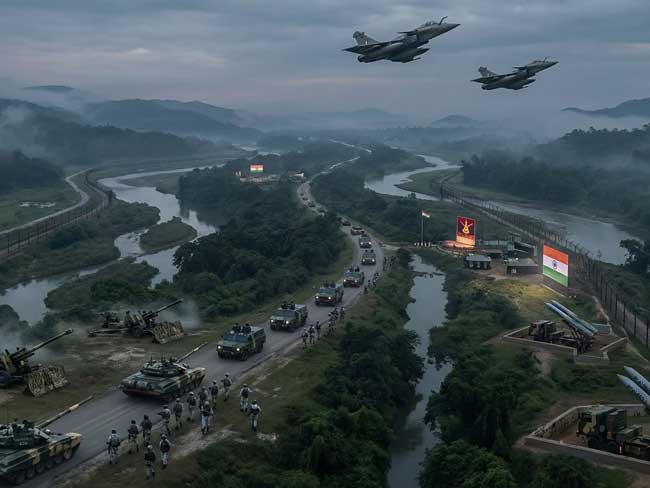
Today, the Siliguri Corridor is no longer merely a narrow passage—it is one of India’s most fortified strategic zones.
Political Noise in Bangladesh, Strategic Reality in India
Bangladesh’s internal political transition after the fall of Sheikh Hasina’s government in 2024 and the rise of an interim administration under Muhammad Yunus has created an atmosphere of uncertainty. In such moments, externalizing domestic frustration often becomes politically expedient.
India has been cast as a convenient target—particularly because Sheikh Hasina currently resides in India. Yet, public anger and political slogans do not translate into military or strategic capability. Despite aggressive rhetoric, Bangladesh’s leadership and armed forces remain acutely aware of the economic, energy, and security interdependence between the two nations.
This makes threats against India’s territorial lifelines more symbolic than substantive.
India’s Military Posture: From Perceived Weakness to Strategic Deterrence
India has long recognized the strategic importance of the Siliguri Corridor and has invested heavily in securing it:
- New military garrisons in Dhubri (Assam), Kishanganj (Bihar), and Chopra (West Bengal) allow rapid troop mobilization and sustained surveillance.
- Advanced air power, including Rafale fighter jets stationed at Hasimara Air Base, ensures air dominance.
- Missile and air-defense systems, such as BrahMos supersonic missile regiments and the S-400 air defense shield, provide deep deterrence.
- Multi-layered ground defenses, supported by mechanized infantry, armored units, special forces, and the Eastern Command’s integrated operational capability, ensure that any hostile movement would be detected and neutralized swiftly.
Senior Indian military officials have repeatedly stated that the Siliguri Corridor is among the most heavily defended regions in the country—capable not only of defense but of containment and counter-offensive action.
Beyond One Corridor: Redundancy and Resilience
India has also reduced strategic dependence on a single corridor. Alternative rail and road projects, enhanced inland connectivity, access to maritime routes via Myanmar, and multi-country transit arrangements through Nepal and Bangladesh itself are gradually strengthening logistical resilience.
Additionally, Bhutan—India’s most trusted strategic partner in the region—remains a critical stabilizing factor. The 2017 Doklam standoff made it clear that Bhutanese territory cannot be used against India, diplomatically or militarily.
The China-Pakistan Factor: Perception Versus Practicality
Speculation often arises about a hypothetical China-Pakistan coordination aimed at pressuring the Siliguri Corridor. In reality, such scenarios collapse under scrutiny:
- Pakistan is geographically distant and strategically constrained.
- China faces severe geographic, diplomatic, and operational limitations in attempting any direct action through the India-Bhutan-Nepal tri-junction.
- Since Doklam, Beijing is fully aware that India will respond firmly—both militarily and diplomatically—to any attempt at altering the status quo.
The notion of a coordinated external squeeze remains more a product of strategic anxiety than strategic feasibility.
Conclusion: India’s Confidence Is Not Accidental
The Siliguri Corridor today is not a fragile link—it is a convergence of military preparedness, diplomatic depth, infrastructure expansion, and technological surveillance. What was once labeled a vulnerability has been systematically transformed into a zone of strength.
Street protests and political slogans may generate headlines, but power in international relations is measured by preparedness, capability, and resolve. On all three counts, India stands secure.
The message is unambiguous:
Threats may be loud, but readiness is silent—and decisive.