
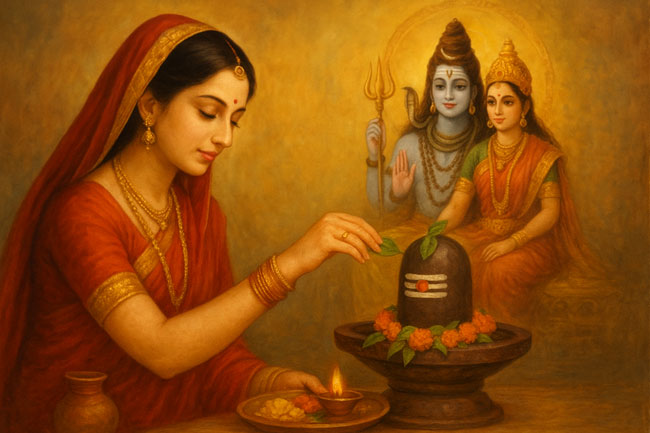
The first drops of monsoon rain do more than quench a thirsty land. They awaken something deeper within the  human spirit. As the fragrance of wet earth rises into the air, millions of hearts across India prepare to welcome one of the most sacred periods of the Hindu calendar—Sawan, the holy month dedicated to Lord Shiva.
Sawan is not merely a month marked on a calendar. It is a season of devotion, introspection, discipline, and spiritual renewal. In 2026, according to the North Indian lunar calendar, the month of Sawan begins on July 30 and concludes on August 28. During this period, devotees will observe four Sawan Mondays, considered especially auspicious for the worship of Lord Shiva.
The Sacred Story Behind Sawan
The spiritual significance of Sawan is deeply connected to the ancient legend of Samudra Manthan—the Churning of the Cosmic Ocean. According to Hindu scriptures, when the deadly poison Halahala emerged from the ocean, it threatened the existence of all creation. To save the universe, Lord Shiva consumed the poison and held it in his throat, earning the name Neelkanth, the Blue-Throated One.


Sawan is believed to commemorate this supreme act of sacrifice and compassion. Throughout the month, devotees offer water, milk, and sacred bilva leaves to Shiva, expressing gratitude for the divine force that absorbs suffering and protects life.
A Month of Inner Transformation
The true essence of Sawan extends beyond rituals and temple visits. Lord Shiva himself symbolizes simplicity, detachment, and balance. Crowned with the moon, adorned with serpents, covered in sacred ash, and dwelling beyond worldly comforts, Shiva reminds humanity that spiritual wealth is greater than material abundance.
The deeper message of Sawan is not merely to perform worship, but to transform oneself. Forgiving an old grievance, overcoming anger, practicing humility, helping someone in need, or cultivating inner peace can be as sacred as any ritual performed before a shrine.
The Spiritual Power of Sawan Mondays
Mondays during Sawan hold special significance for devotees. Many observe fasts, visit temples, perform Rudrabhishek, and chant the powerful mantra “Om Namah Shivaya.”
Yet fasting, in its highest sense, is not simply abstaining from food. It is abstaining from negativity, ego, harmful speech, and destructive thoughts. It is a conscious effort to purify the mind and strengthen self-discipline.
In a world driven by constant distraction and desire, Sawan offers an invitation to slow down and reconnect with one’s inner self.
Mangala Gauri: Celebrating the Divine Feminine
The Tuesdays of Sawan are dedicated to Goddess Gauri, the divine consort of Lord Shiva. Through Mangala Gauri Vrat, devotees seek blessings for prosperity, harmony, and family well-being.
Beyond its traditional observance, the worship of Gauri represents reverence for the feminine principle—the power of creation, compassion, endurance, and nurturing energy that sustains life itself. It reminds us that spiritual balance is achieved through the union of Shiva and Shakti, consciousness and energy.
When Nature Becomes a Temple
There is perhaps no other season in India where nature and spirituality blend so seamlessly. The dark monsoon clouds, flowing rivers, lush green landscapes, and rhythmic rainfall create an atmosphere that naturally inspires contemplation.
Ancient saints, poets, and mystics often described Sawan as a time when the veil between the human soul and the divine becomes thinner. The rain seems to wash away not only the dust from the earth but also the burdens carried within the heart.
It is a season that encourages silence in a noisy world and reflection in an age of constant movement.
The Eternal Message of Sawan
At its core, Sawan teaches a timeless truth: true strength lies in humility, true wealth lies in simplicity, and true peace lies within.
The month reminds us that spirituality is not an escape from life but a deeper engagement with it. It is an opportunity to pause, reflect, and rediscover the sacred presence that resides within every being.
As the monsoon clouds gather and the chants of “Har Har Mahadev” echo through temples and homes, Sawan invites us to embark on a journey—not to a distant pilgrimage site, but into the depths of our own consciousness.
And perhaps, amid the rain, the prayers, and the silence, we may discover that the path to Kailash has always begun within.
Har Har Mahadev.