

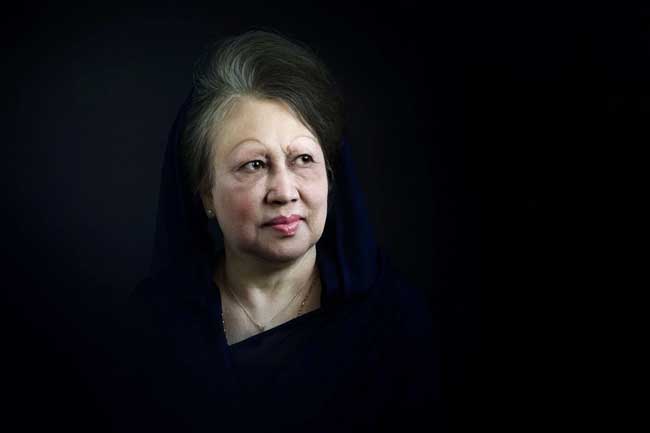
Her passing at the age of 80 marks not merely the end of a former prime minister’s life, but the closing of an entire era in Bangladesh’s political history—an era defined by relentless rivalry, ideological confrontation, and personal resilience.
Among the many episodes that shaped her long public life, one moment stands out not for its drama or triumph, but for its silence—an unfinished meeting in 2013.
That year, India’s then President Pranab Mukherjee arrived in Dhaka on a historic visit—the first ever by an Indian president to Bangladesh. The visit symbolized continuity, trust, and maturity in bilateral relations. As part of the itinerary, a meeting between President Mukherjee and Bangladesh’s then Leader of the Opposition, Khaleda Zia, had been scheduled.


Everything was in place.
The time was set. The venue decided.
Yet the meeting never happened.
At the last moment, Khaleda Zia withdrew—citing a threat to her life.
Dhaka at the time was tense. The streets were witnessing violent protests by Jamaat-e-Islami supporters opposing war crimes convictions of their leaders. Politics had spilled far beyond parliament and into public spaces. In that charged atmosphere, Khaleda Zia received intelligence inputs warning that an attack on her was possible if she proceeded to the meeting.
In a later interview, she said plainly: had anything happened to her, the blame would not have been ambiguous.
This was not a political excuse, but a human fear—of a leader out of power, surrounded by hostility, navigating an environment where security itself had become politicized.
The decision drew criticism from the ruling Awami League government, which viewed it as an unnecessary breach of diplomatic protocol. But with the passage of time, the episode calls less for judgment and more for understanding.
In politics, stepping back can also be a decision.
And not every decision is born of strength—some are born of survival.
The irony is that just a year earlier, in 2012, Khaleda Zia had met Pranab Mukherjee in New Delhi. The channel of dialogue had not collapsed; it simply could not be crossed on that particular day.
Today, in the wake of her passing, that canceled meeting remains a quiet footnote in history—
an Indian president waiting,
and a Bangladeshi opposition leader held back by fear and circumstance.
Khaleda Zia’s life was not merely about holding office, but about endurance.
Through accusations, imprisonment, political isolation, and failing health, she remained a central figure in Bangladesh’s public life.
Her death reminds us that politics is not only about power and victory.
It is also about vulnerability, loneliness, and conversations that never take place.
As we remember Khaleda Zia, we are not just bidding farewell to a leader, but to a time in South Asian politics that was deeply personal, intensely adversarial, and often perilous.
Her name will remain etched in history—
beyond controversies,
beyond rivalries—
as a testament to an era that shaped Bangladesh’s destiny.