
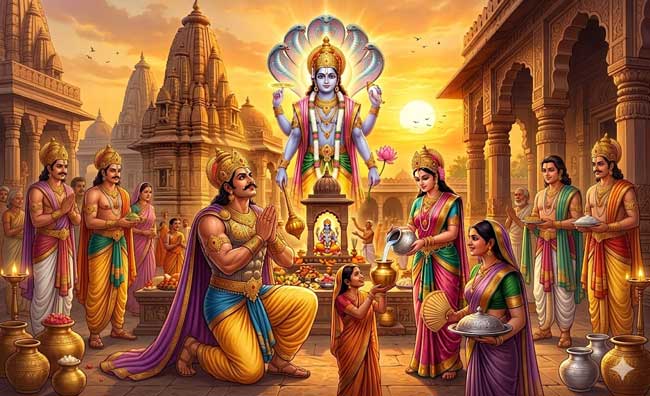
Among all the Ekadashis observed in the Hindu calendar, Nirjala Ekadashi holds a unique and revered place.  Considered one of the most austere and spiritually rewarding fasts, it requires devotees to abstain not only from food but also from water for an entire day. While most Hindu fasts permit the consumption of fruits, milk, or water, Nirjala Ekadashi stands apart because even a sip of water is traditionally avoided.
But why is drinking water prohibited on this day? The answer lies in an ancient story from the Mahabharata and in the deeper spiritual symbolism of self-discipline and devotion.
The Meaning of Nirjala
The word “Nirjala” literally means “without water.” Observed on the Ekadashi (eleventh lunar day) of the bright fortnight of the Hindu month of Jyeshtha, this fast is regarded as the most rigorous among all Ekadashi observances.


According to Hindu tradition, observing Nirjala Ekadashi with sincerity grants the spiritual merit of all twenty-four Ekadashis observed throughout the year. For this reason, it is often called the “King of Ekadashi Fasts.”
The Mahabharata Connection
The origins of Nirjala Ekadashi are closely linked to the Mahabharata. The story revolves around Bhima, the mighty Pandava known for his immense strength and equally powerful appetite.
Unlike his brothers—Yudhishthira, Arjuna, Nakula, and Sahadeva—and their mother Kunti, Bhima found it extremely difficult to observe regular fasts. Though devoted to righteousness, he struggled to remain without food.
Seeking guidance, Bhima approached the sage Vyasa and confessed his inability to observe every Ekadashi fast throughout the year. He asked if there was a way to obtain the same spiritual benefits without undertaking multiple fasts.
Sage Vyasa advised him to observe a single, highly disciplined fast on the Jyeshtha Shukla Ekadashi. He instructed Bhima to abstain from both food and water for the entire day and dedicate himself to the worship of Lord Vishnu. Vyasa explained that faithfully observing this one fast would grant the merit of all the Ekadashis of the year.
Because of this association, Nirjala Ekadashi is also known as “Bhimseni Ekadashi.”
Why Is Water Forbidden?
From a spiritual perspective, water symbolizes life itself. Human beings can survive without food for a considerable period, but going without water is far more challenging. Therefore, giving up water is regarded as the ultimate test of self-control and devotion.
The purpose is not self-punishment but mastery over desires and attachment. Hindu scriptures emphasize that spiritual growth often begins when a person learns to exercise restraint over even the most basic physical needs.
By voluntarily enduring thirst, devotees seek to strengthen their inner discipline, deepen their concentration, and cultivate a stronger connection with the Divine.
The Deeper Spiritual Message
Nirjala Ekadashi is not merely about abstaining from food and water. At its heart, it is a practice of purification—of body, mind, and spirit.
The fast teaches that true strength does not come from physical power alone but from the ability to control one’s senses and desires. It encourages gratitude for life’s essential blessings and reminds individuals not to take even the simplest necessities, such as water, for granted.
The observance also inspires humility, patience, and faith, qualities that are central to spiritual growth.
The Importance of Charity
An important aspect of Nirjala Ekadashi is charity. Devotees are encouraged to donate water-filled pots, fans, umbrellas, clothing, fruits, and cooling refreshments to those in need.
Since the festival falls during one of the hottest periods of the year in India, offering water and relief to others is considered a highly meritorious act. Thus, Nirjala Ekadashi combines personal spiritual discipline with compassion and service to humanity.
A Day of Devotion and Self-Mastery
Nirjala Ekadashi remains one of Hinduism’s most profound observances because it represents the triumph of discipline over desire. The abstinence from water is not an end in itself but a symbol of complete surrender to faith and self-control.
For millions of devotees, the fast serves as a reminder that spiritual fulfillment often begins when one learns to master the needs of the body and awaken the strength of the soul.