
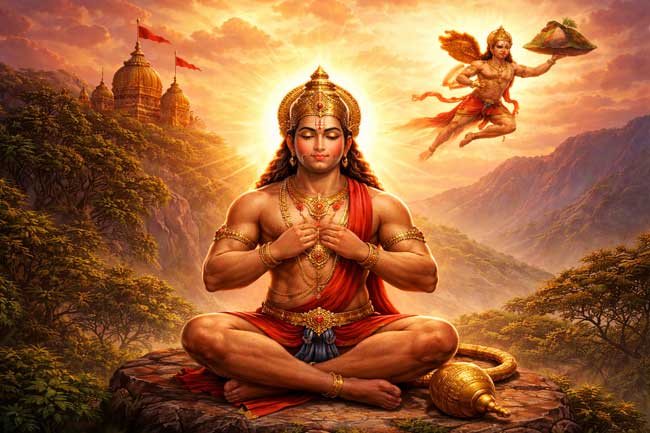
 Mangalwar is not merely a day in the weekly cycle; it represents an inner current of energy that liberates a human being from fear and directs him toward duty. In the Indian spiritual tradition, this day is especially associated with the worship of Hanuman. Yet a deeper question arises: Is Mangalwar about devotion, or about strength?
At first glance, Mangalwar appears to symbolize valor and dynamism. The color red, the influence of Mars, courage, struggle, and determination—all seem to point toward power. In Vedic astrology, Mangal is regarded as the governing force of energy, enthusiasm, and disciplined action. However, when we look beyond the surface, we realize that this power is not wild or chaotic. It is purposeful, restrained, and aligned with a higher moral order.
This is where devotion enters.


The character of Hanuman offers perhaps the most harmonious answer to this apparent duality. He embodies immeasurable strength, yet his power is never rooted in ego. It flows from surrender and service. His courage is not self-centered ambition but an expression of unwavering devotion. Strength without devotion can become destructive, while devotion without strength may become passive. Mangalwar teaches the essential balance between the two.
In the modern world, this lesson feels increasingly relevant. Society often celebrates aggression as strength and competition as success. If the energy associated with Mangal is misunderstood as mere force or dominance, it can lead to inner restlessness and fractured relationships. But when that same energy is refined into self-discipline and moral courage, it transforms into resilience—the ability to stand firm in adversity without losing compassion.
Observing a fast on Mangalwar is not simply abstaining from food; it is a symbolic act of restraint. It calls for the renunciation of ego, anger, jealousy, and impulsiveness. The day reminds us that authentic strength lies not in overpowering others but in mastering oneself. True heroism is internal before it is external.
Devotion, therefore, is not an escape from action. It is the inner anchoring that gives direction to power. When strength is guided by devotion, it becomes a force for righteousness. That is why Hanuman is revered not only as a warrior but as the supreme devotee. In him, power and humility coexist seamlessly.
Ultimately, the question “Devotion or Strength?” resolves itself into a deeper truth: Mangalwar calls us to cultivate both. Humility in the heart, courage in conduct, discipline in thought, and surrender in spirit.
That is the enduring spiritual message of Mangalwar.