
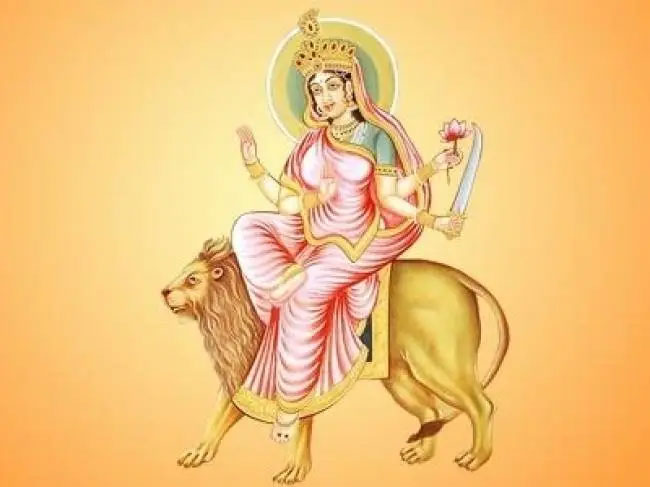
 The sixth day of Navratri brings us to a profound spiritual threshold, where devotion transcends ritual and becomes a way of living. Worshipped on this day, Maa Katyayani is not merely a divine figure, but a living embodiment of three fundamental forces within human consciousness—resolve, courage, and attainment. This sacred confluence forms the very foundation of every struggle, every pursuit, and every fulfillment in life.
The origin of Maa Katyayani, as described in ancient texts, reflects a deeper spiritual truth. When injustice rises beyond limits, passive faith alone is not enough; it demands the awakening of firm resolve. Born from the collective energies of the divine, Maa Katyayani symbolizes the power that emerges when one gathers inner strength with unwavering determination. Resolve, therefore, is the first dimension of her form—a steadfast commitment that does not falter in the face of adversity.
However, resolve by itself remains incomplete without courage. A determination without the strength to act is merely an idea. Maa Katyayani, depicted riding a lion, represents this fearless courage. This courage is not limited to physical battles, but extends to the subtle, internal conflicts we face every day—the fears, doubts, and uncertainties that challenge our stability. Her message is clear: one who cannot conquer the self cannot conquer the world. Courage, in its truest sense, is the ability to stand firm even when the ground beneath feels uncertain.


When resolve and courage unite, the path to attainment naturally unfolds. Attainment, or siddhi, is not merely about achieving external success; it is a state of alignment where effort and purpose become one. The blessings of Maa Katyayani signify this completeness—a state where actions are no longer driven by fear or hesitation, but by clarity and inner strength. True attainment arises when resolve is unwavering and courage is consistent.
In the context of modern life, where instability, fear, and uncertainty often dominate, the Triveni form of Maa Katyayani becomes even more relevant. Today, the greatest challenges are not always external, but internal. Despite having clear goals and abundant opportunities, individuals often find themselves held back by hesitation and self-doubt. In such times, the worship of Maa Katyayani is not just a religious act, but a means of deep self-reflection.
Her essence teaches us to transform resolve into action, to embody courage in our decisions, and to understand attainment not merely as a result, but as an ongoing journey. This is the true practice of her worship.
Ultimately, the Triveni form of Maa Katyayani reminds us that victory in life does not arise from external forces alone, but from the harmonious balance of these three inner streams. When resolve is clear, courage is unwavering, and attainment becomes a process rather than a destination, life itself transforms into a spiritual path. This is her eternal message—one that extends far beyond Navratri and into every moment of our existence.