
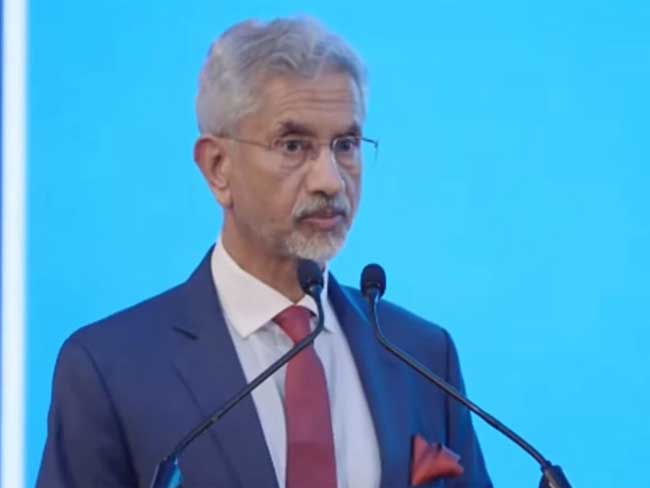
Jeju : External Affairs Minister S. Jaishankar on Thursday emphasized the need for deeper cooperation between India and South Korea, highlighting strong complementarities between the two countries across sectors “from ships to chips,” which he said could help build a more resilient global order.
Delivering the keynote address at the Jeju Forum for Peace and Prosperity 2026 during his two-day visit to the Republic of Korea (June 24–25), Jaishankar said the world is increasingly moving toward fragmentation, but also needs to find new pathways for cooperation.
He said he agreed with the forum’s framing of a fragmented world as both a challenge and an opportunity, noting, “Fragmentation is here to stay, and in some ways, it is not entirely negative. It reduces dominance, creates more space, and allows greater democratization.”


Jaishankar observed that despite geopolitical tensions, the global system remains highly interconnected through economic integration and interdependence, especially in supply chains and resource networks. He stressed that this interdependence is not limited to goods but extends to critical resources as well.
Highlighting the growing role of technology, he said artificial intelligence will further accelerate global integration because data flows and model deployment are inherently transnational.
At the same time, he cautioned that global challenges such as pandemics, terrorism, and climate-induced disasters cannot be contained within national borders, making international cooperation essential. He also invoked India’s civilizational ethos of “Vasudhaiva Kutumbakam”—the world as one family.
Jaishankar warned that strategic considerations are increasingly influencing economic relations and connectivity, including supply chains and critical infrastructure. He also criticized restrictions that limit industrialization in developing countries, stating that access to markets and competitiveness is often being manipulated in ways that disadvantage the Global South.
Describing the current global environment, he said there is growing “weaponization of everything,” higher risk-taking in geopolitics, and decision-making increasingly shaped by the social media era, often overlooking broader societal costs.
To address these challenges, he outlined five key approaches: de-risking the global economy and diversifying supply chains; building closer cooperation among influential nations; protecting international law including frameworks such as UNCLOS; empowering the Global South; and advancing reformed multilateralism.
Linking these ideas to bilateral relations, Jaishankar said the five priorities strongly support closer India–South Korea cooperation. “We have strong complementarities in many fields—from ships to chips—as well as in health, infrastructure, and defense, which are waiting to be further developed,” he said.
He added that discussions in Seoul had focused on strengthening economic, technological, strategic, and people-to-people ties, underscoring the growing importance of the India–South Korea partnership in an increasingly fragmented world.