

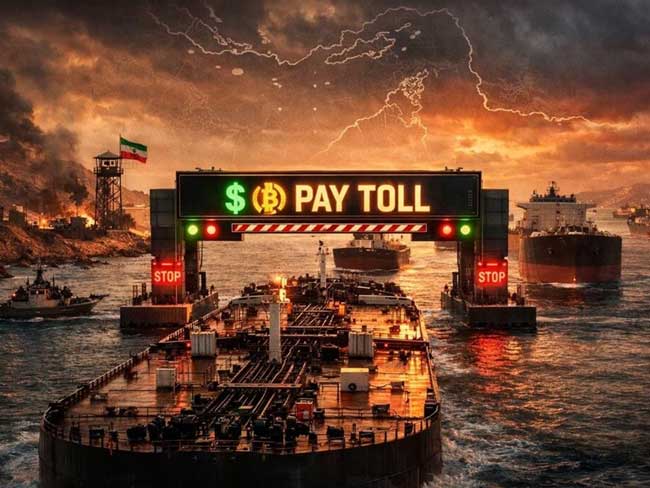
Following a two-week ceasefire mediated by Pakistan between the United States and Iran, Tehran is now planning to levy a toll on ships passing through the Strait of Hormuz. Before the conflict, this crucial waterway was entirely free for maritime traffic, but the imposition of tolls is expected to push global oil prices higher. However, such a move would constitute a clear violation of international maritime trade rules.
According to the United Nations Convention on the Law of the Sea (UNCLOS), implemented in 1994, fees can only be imposed on foreign vessels for specific services provided to them, and not merely for transiting through territorial waters.
Iran’s Toll Plan
The Financial Times reports that Hamid Husseini, spokesperson for the Iranian Association of Oil, Gas, and Petrochemical Exporters, said Iran intends to monitor every vessel passing through Hormuz. He indicated that shipping companies would need to pay a toll of one dollar per barrel of oil for their tankers to receive permission to transit. Husseini added, “Iran needs to ensure that this two-week period is not used for the illicit movement of weapons.”


Legal Controversy
Article 17 of UNCLOS guarantees ships the right to “innocent passage” through territorial seas, as long as the passage does not harm the coastal state’s peace, security, or order. Article 26 further clarifies that a coastal state cannot charge foreign ships merely for transiting its waters. Fees can only be levied for specific services provided, and they must be applied without discrimination.
If Iran imposes tolls solely for passage, it would violate international maritime law as well as principles enshrined in the United Nations Charter.
Hormuz in the 10-Point Agreement
The two-week ceasefire followed a 10-point agreement mediated by Pakistan, which also included provisions related to the Strait of Hormuz. While the US and Iran reportedly agreed on most points, some disagreements were recorded. The plan affirmed Iran’s continued control over Hormuz, through which roughly one-fifth of the world’s oil supply passes.
According to the Associated Press, one provision of the plan allows Iran and Oman to charge fees on vessels passing through the strait. The collected revenue is reportedly intended for regional reconstruction projects.