
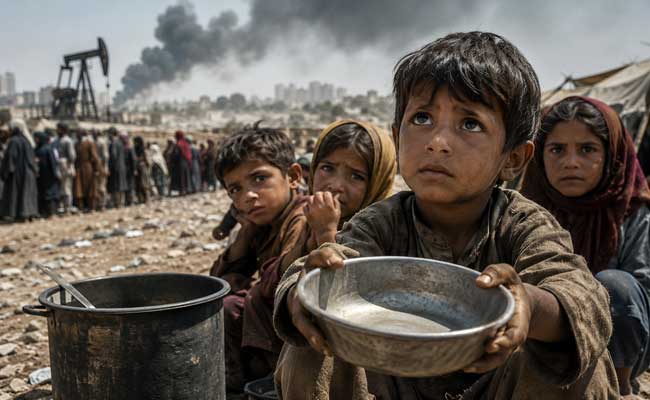
Desk : The United Nations World Food Programme (WFP) has warned that the ongoing conflict involving Iran is driving millions of people deeper into hunger, particularly in vulnerable countries already struggling with food insecurity. The agency said rising fuel and food prices, triggered by the conflict and sustained high oil prices, are worsening conditions for millions worldwide.
According to a recent WFP assessment, an additional 2.5 million people in Somalia, 2.3 million in Afghanistan, and 1.3 million in Sri Lanka are now facing difficulties in meeting their basic food requirements as the economic fallout from the conflict spreads.
Earlier this year, the WFP projected that up to 45 million more people could fall into food insecurity by the end of June, adding to the estimated 318 million people already experiencing acute food shortages globally. The agency has reaffirmed that projection, citing the strong link between energy costs and food prices.


Speaking to reporters at the United Nations, WFP Acting Executive Director Carl Skau said that in many low-income countries, households already spend most of their income on food. As food prices continue to rise, families are forced to reduce consumption, increasing the risk of malnutrition and hunger.
The Rome-based agency stated that the Middle East crisis is creating significant ripple effects across global markets, particularly through higher fuel and food costs and disruptions to trade. These pressures are having a rapid impact on food security and livelihoods in countries that are already economically fragile.
WFP warned that the consequences are likely to persist and could intensify in the coming months, even if tensions in the Middle East begin to ease.
Skau also highlighted several other regions facing severe food insecurity, including Sudan, Gaza, southern Lebanon, Yemen, and Haiti.
At the same time, the WFP said funding shortfalls have forced it to scale back assistance programs for millions of vulnerable people. The agency appealed to international donors to increase support, particularly for Somalia and Afghanistan, warning that failure to act could result in devastating humanitarian consequences.