
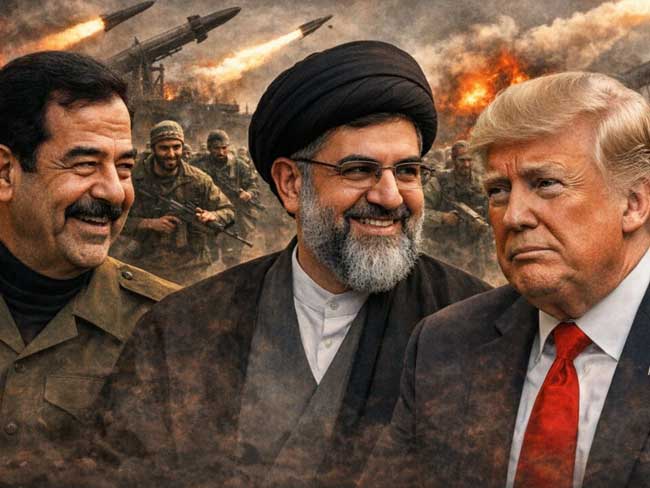
Iran appears to be gearing up for a protracted confrontation with the United States and Israel, drawing historical parallels to tactics employed by Saddam Hussein decades ago. Analysts say the move signals Tehran’s intent to sustain conflict over years, rather than seeking a quick resolution.
A Historical Playbook
Reports suggest that Iran is now recruiting children as young as 12 into military support roles under the supervision of the Islamic Revolutionary Guard Corps (IRGC). While these minors are officially engaged in auxiliary duties such as logistics, surveillance, and base support, officials emphasise that early training is intended to foster long-term ideological loyalty.
The approach has drawn international criticism, with human rights groups warning that the enlistment of children violates global norms and could institutionalise militarisation among youth for decades.

Observers note that this strategy bears resemblance to Saddam Hussein’s post‑World War II tactics in Iraq, where youth were systematically trained to build a long-term loyal military force.
Strategic Context
The development comes amid ongoing tensions following coordinated strikes by the US and Israel against Iranian targets on February 28, 2026. Tehran has publicly condemned the attacks and mobilised forces across multiple fronts.
Analysts highlight that Iran is employing a mosaic defence strategy, decentralising military command to ensure resilience against conventional attacks and to sustain long-term engagement even if key leaders or infrastructure are targeted.
“The lowering of recruitment age is a deliberate move to create a generation deeply committed to Iran’s military and ideological objectives,” said a regional security expert. “It signals Tehran’s preparation for a multi-decade confrontation, rather than a short-term conflict.”
Implications for Regional Security
Iran’s long-term preparation could have profound implications for the Middle East. By embedding military discipline and ideological training from an early age, Tehran is essentially militarising its society for the long haul.
International observers caution that such steps may prolong hostilities and complicate diplomatic efforts, raising concerns about regional stability and the potential for wider escalation.
While the full scale of Iran’s new military policy remains unclear, experts agree that the country’s emphasis on youth mobilisation, ideological continuity, and decentralised military doctrine marks a significant shift in Tehran’s approach to conflict with the US and Israel.