

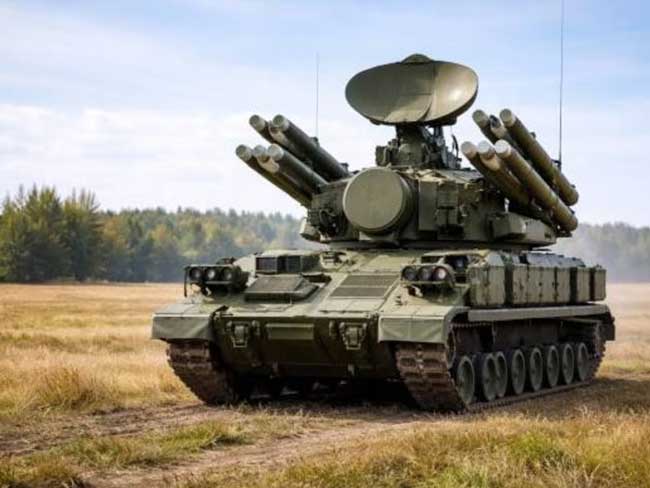
In a strategic move to strengthen its air defence capabilities, India has signed a ₹445-crore deal with Russia for the procurement of the Tunguska air defence missile system. This acquisition comes at a time when the Indian armed forces are facing growing challenges from low-altitude aerial threats, including drones, helicopters, and cruise missiles, which require rapid and layered responses.
The Defence Ministry confirmed the deal on March 27, 2026, stating that the Tunguska system will serve as a critical supplement to India’s existing S-400, Akash, and Barak-8 air defence networks. Analysts suggest that while high-end systems like the S-400 are effective against high-speed, high-altitude targets, smaller and slower-moving threats such as drones require dedicated short-range systems like Tunguska for immediate response.
What is the Tunguska System?
The Tunguska (2K22) is a mobile, short-range air defence system developed in Russia, primarily designed to counter low-flying aerial targets. The system combines surface-to-air missiles with twin 30mm autocannons, providing both precision and versatility in neutralising a wide range of threats.


Key features include:
- Dual-layered defence: Missiles for precision strikes at longer short-range distances, and autocannons for immediate close-range interception.
- Mobility: Mounted on tracked vehicles, the system can move with army units or be deployed at critical strategic locations.
- Effective against drones: Particularly capable of targeting drone swarms, helicopters, light aircraft, and cruise missiles, which are becoming increasingly common in modern conflict scenarios.
The system’s design allows it to respond quickly to multiple threats simultaneously, making it ideal for the protection of forward-operating bases, military convoys, and key infrastructure.
Why India Needs Tunguska
The Indian armed forces have increasingly encountered low-altitude threats, particularly from drones used for surveillance and attack. Incidents during Operation Sindoor, where Pakistan allegedly used drones to target sensitive areas, highlighted the need for an effective short-range defence system.
Military analysts emphasize that drone swarms present a unique challenge: while traditional air defence systems are designed for high-speed aircraft or missiles, drones are smaller, slower, and harder to detect with radar alone. The Tunguska system’s rapid-response capability ensures that even small or agile aerial targets can be intercepted before causing damage.
Strategic and Regional Implications
The purchase of Tunguska not only strengthens India’s tactical air defence but also deepens India-Russia defence cooperation, which has historically been a cornerstone of India’s military strategy. With this acquisition, India positions itself to:
- Enhance layered air defence: Complement existing systems like S-400 and Barak-8 with short-range, rapid-response capabilities.
- Counter emerging threats: Protect strategic military and civilian installations from low-altitude and drone-based threats.
- Maintain regional deterrence: Signal to neighbouring countries, including Pakistan and China, that India is rapidly upgrading its defensive readiness.
Experts note that in the evolving battlefield landscape, cost-effective aerial threats like drones can no longer be ignored. The integration of the Tunguska system ensures that India is not only prepared for conventional attacks but also for asymmetric aerial warfare.
Conclusion :-The Tunguska deal marks a significant step in modernising India’s air defence network, reflecting a shift towards a multi-layered, technology-driven approach. By combining long-range, mid-range, and short-range systems, India is creating a robust air defence umbrella capable of neutralising a variety of aerial threats.
This procurement underscores India’s commitment to defence preparedness, strategic partnerships, and rapid adaptation to new warfare technologies in an increasingly complex regional security environment.