

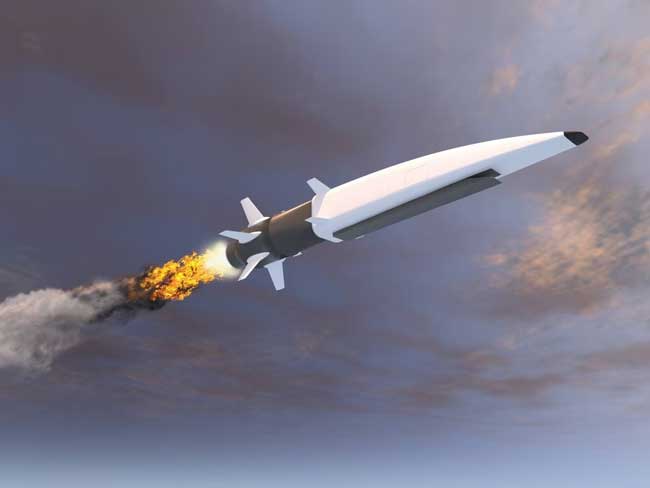
New Delhi. India is advancing rapidly in the development of advanced hypersonic weapons systems, marking a significant step in strengthening its future defence capabilities. According to defence experts and official sources, the country is moving closer to operational readiness of high-speed missile systems that could reshape the regional security balance.
The hypersonic weapons under development are expected to travel at speeds between Mach 5 and Mach 10, making them several times faster than conventional ballistic missiles. Their ability to change trajectory during flight makes them extremely difficult to detect, track, or intercept using existing air defence systems.
The Defence Research and Development Organisation (DRDO) has been working on this technology for several years as part of India’s long-term strategic defence roadmap. Experts say these systems are not only about speed but also about precision, manoeuvrability, and reduced reaction time for adversaries.


Strategic Implications for the Region
Defence analysts believe that this advancement significantly enhances India’s deterrence capability, especially in the context of regional security dynamics involving China and Pakistan. The deployment of such technology is expected to alter the existing strategic balance in South Asia.
Military observers note that hypersonic capability adds a new layer of complexity to modern warfare, as it reduces the time available for response and challenges conventional missile defence systems.
Possible Space-Based Integration
Reports also suggest that India is exploring the integration of advanced missile systems with satellite-based surveillance and targeting networks. Such integration could improve real-time tracking, accuracy, and response coordination, marking a shift towards network-centric warfare capabilities.
A New Era in Warfare Technology
Hypersonic weapons are widely regarded as a defining feature of next-generation warfare. Their combination of extreme speed, manoeuvrability, and precision makes them a game-changing element in global military technology development.