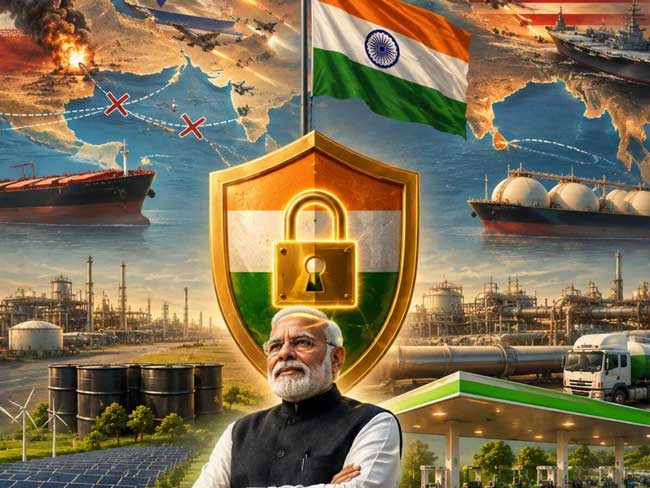
The Middle East conflict and subsequent closure of the Strait of Hormuz triggered a severe disruption in the global energy system. The strait handles nearly one-fifth of the world’s crude oil trade, making it one of the most critical energy chokepoints.
Following reported strikes by the United States and Israel on Iran in late February, Tehran responded by fully shutting the Strait of Hormuz. This led to an immediate breakdown in global oil supply chains and a sharp spike in prices across international markets.
India: High Exposure, Controlled Impact
India imports nearly 90% of its crude oil and around 60% of its LPG requirements, a significant portion of which passes through the Strait of Hormuz. The crisis therefore posed a serious risk to India’s energy security and macroeconomic stability.
However, despite the prolonged four-month disruption, India avoided any visible domestic fuel shortage. Petrol pumps did not witness long queues, LPG supply remained stable, and overall economic activity continued normally.
Historic Surge in Oil Prices
During the crisis, global crude oil prices crossed the $100 per barrel mark. India’s crude basket surged from around $70 to over $120 per barrel within weeks. Brent crude touched an all-time high of $126 per barrel.
LPG contract prices rose by nearly 46% between February and June, pushing import costs sharply higher. Rising war-risk insurance premiums further added to the cost burden on imports.
India’s Strategic Response
The government responded quickly with strict regulatory and supply-side measures. Domestic production was pushed, supply chains were optimized, and alternative sourcing was rapidly expanded.
A key policy decision was taken not to pass the full cost burden directly to consumers. Instead, public sector oil marketing companies absorbed the shock, ensuring retail price stability for households.
Excise duty adjustments and targeted fiscal measures were also used to stabilize the market while maintaining supply continuity.
Impact of a Decade of Energy Reforms
Structural reforms over the past decade played a crucial role in cushioning the shock.
India expanded its LPG import terminals from 11 to 22, while total import capacity increased from 12 million tonnes per year to over 32 million tonnes by 2026.
Crude oil sourcing diversified significantly—from 27 countries in 2014 to 41 countries in 2026. New suppliers such as Libya, Gabon, Equatorial Guinea, and Guyana were added, while imports from the United States and Russia increased substantially.
The expansion of ethanol blending programs also reduced crude import dependence, contributing to long-term structural resilience.
Economic Pressure and Government Intervention
After more than two months of stable retail pricing, petrol and diesel prices were eventually increased by up to ₹7 per litre.
Oil marketing companies reportedly faced daily under-recoveries running into hundreds of crores, while the government absorbed significant fiscal losses through excise duty cuts estimated at around ₹1.7 lakh crore.
Despite this, policy makers prioritized price stability and supply security over short-term fiscal concerns.
India vs Other Affected Economies
The crisis impacted several import-dependent economies across Asia far more severely.
Sri Lanka introduced fuel rationing and a four-day work week. Pakistan reduced working days and closed schools. Myanmar implemented odd-even driving restrictions and QR-based fuel rationing. Bangladesh deployed security forces to protect fuel reserves, while Ethiopia halted supply in certain regions.
Developed economies relied heavily on strategic petroleum reserves and subsidies. Japan drew down reserves and increased subsidies, South Korea imposed price controls for the first time in decades, and European Union countries announced multi-billion-euro relief packages.
India, in contrast, did not declare an emergency, impose rationing, or reduce working hours. Only selective export restrictions on industrial fuels were implemented to safeguard domestic needs.
Macroeconomic Stability Remained Intact
Despite external shocks, India’s foreign exchange reserves remained strong, exceeding $728 billion at their peak during the crisis period.
GDP growth stayed near 7%, while inflation remained within the central bank’s target range. The current account deficit also remained under control, reflecting macroeconomic stability despite global volatility.
Post-Hormuz Normalization
Following a US-Iran peace agreement in June, the Strait of Hormuz was reopened and maritime traffic resumed. The first Indian-flagged LNG vessel, Disha, carrying around 62,000 tonnes of cargo, returned safely after a three-month disruption.
Crude oil prices eased to around $74 per barrel, with expectations of further stabilization as supply chains normalize. However, clearance of naval mines and recovery of stranded vessels is expected to take additional time.
India currently maintains around two months of crude and LPG stockpiles, along with 5.33 million tonnes of strategic petroleum reserves. Expansion projects at Chandikhole and Padur are expected to further strengthen storage capacity.
Outlook
Experts believe that India’s handling of the Hormuz crisis will strengthen long-term energy security and improve preparedness for future global supply shocks, reinforcing its position as a resilient major energy importer in an uncertain world.