

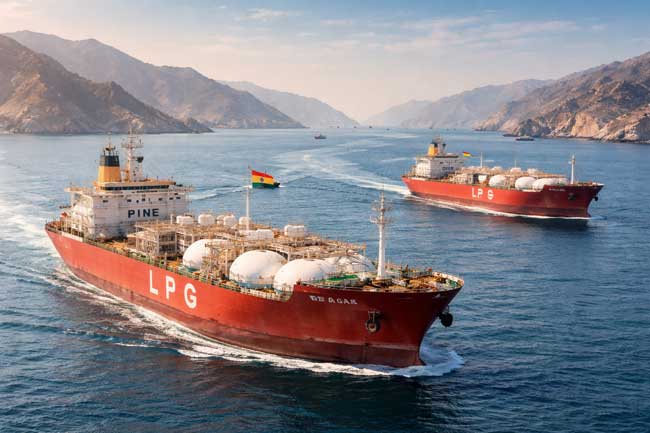
In a reassuring development for India’s energy security, two Indian LPG tankers — Pine Gas and Jag Vasant — have successfully crossed the Strait of Hormuz, amid earlier reports of steep transit fees in the region. Both vessels are expected to reach India by the end of March.
Coordinated Transit Through Sensitive Waters
The tankers departed the Persian Gulf on Monday morning, navigating the waters between Larak and Qeshm Islands in Iran to signal their presence to local authorities. Each vessel is carrying roughly 92,000 tonnes of LPG, equivalent to nearly a day’s domestic cooking gas consumption in India.
Rajesh Kumar Sinha, Special Secretary at the Ministry of Ports, Shipping, and Waterways, confirmed, “The journey has commenced,” though he did not disclose the destination ports. Under normal conditions, ships take two to two-and-a-half days to reach India from the Gulf.


These tankers are part of a larger fleet of 22 Indian-flagged vessels recently stranded in the Persian Gulf due to heightened tensions, which had disrupted maritime traffic through the Strait.
Iran Rejects Fee Claims
Reports that ships were being charged $2 million to transit the Strait were refuted by the Iranian Embassy in India. In a post on X, the embassy clarified:
“The claims that the Islamic Republic of Iran is charging $2 million from vessels passing through the Strait of Hormuz are baseless. Statements made in this context reflect personal opinions and do not represent the official position of Iran.”
Earlier Tankers Arrive Safely
Earlier this month, two Indian LPG tankers — MT Shivalik and MT Nanda Devi, carrying 92,712 tonnes of LPG — arrived safely. Shivalik docked at Mundra Port, Gujarat, on 16 March, while Nanda Devi reached Kandla Port on 17 March. Both had crossed the Strait on 14 March.
The Indian-flagged crude oil tanker Jag Ladki, transporting 80,886 tonnes of crude oil, also reached Mundra Port on 18 March. Another tanker, Jag Prakash, bound for Tanzania, has safely crossed the Strait and is carrying gasoline from Oman to Africa.
Securing India’s Energy Lifeline
The safe passage of these tankers highlights the importance of secure maritime corridors for India’s energy imports. With West Asia tensions affecting navigation, close coordination with regional authorities and proactive tracking remain vital to ensure uninterrupted supply of LPG and crude oil, critical for domestic consumption and strategic reserves.