
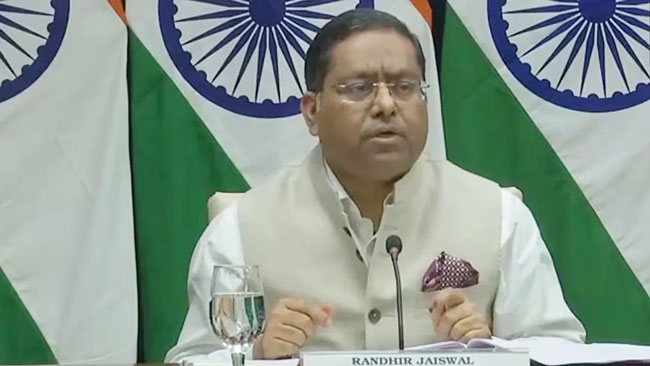
New Delhi : India on Tuesday firmly reiterated that boundary-related issues with Nepal are strictly bilateral matters and cannot involve any third party, emphasizing that both countries already have established mechanisms to address all aspects of border management and dispute resolution.
Speaking during the Ministry of External Affairs’ weekly media briefing, MEA spokesperson Randhir Jaiswal said that nearly 98 percent of the India-Nepal boundary has already been demarcated, while a few segments remain unresolved due to geographical changes, particularly shifts in the course of the Gandak River.
Jaiswal noted that cases of cross-border occupation and encroachment in demarcated “no-man’s land” areas have also been identified in certain sectors. These areas are currently being jointly mapped and verified by authorities from both countries.


“We have established bilateral mechanisms to deal with all aspects of boundary matters. It should be clear to all concerned that there is no role for any third parties in a bilateral matter between India and Nepal,” he said.
The remarks came in response to reports that Nepal Prime Minister Balendra Shah had suggested involving the United Kingdom and China in discussions concerning border-related issues with India. At the same time, Shah reportedly reaffirmed Nepal’s commitment to resolving outstanding boundary disputes through dialogue with India.
The issue has sparked political debate within Nepal, with several political parties criticizing the Prime Minister’s comments regarding alleged encroachments involving both countries. Following the controversy, Nepal’s Foreign Ministry issued a clarification, stating that Shah’s remarks referred to technical matters related to boundary pillars, “Dashgaja” (no-man’s land), and cross-border land usage.
Nepal Foreign Ministry spokesperson Lok Bahadur Paudel Kshetri explained that technical studies have identified areas where land currently being used by Nepal may fall on the Indian side of the border, and vice versa. He stressed that Nepal remains committed to resolving all outstanding boundary issues through diplomatic negotiations based on historical treaties, maps, and bilateral agreements.
The Indian government also recalled its earlier position regarding Nepal’s comments on the Kailash Mansarovar Yatra route through Lipulekh Pass. Last month, Jaiswal stated that Lipulekh has served as a traditional route for the pilgrimage since 1954 and has been used for decades.
He further maintained that India’s position on territorial claims remains unchanged, asserting that unilateral expansion of territorial claims is neither justified nor supported by historical facts and evidence.
India reiterated that it remains open to constructive engagement with Nepal on all bilateral issues, including the peaceful resolution of outstanding boundary matters through dialogue and diplomacy.