
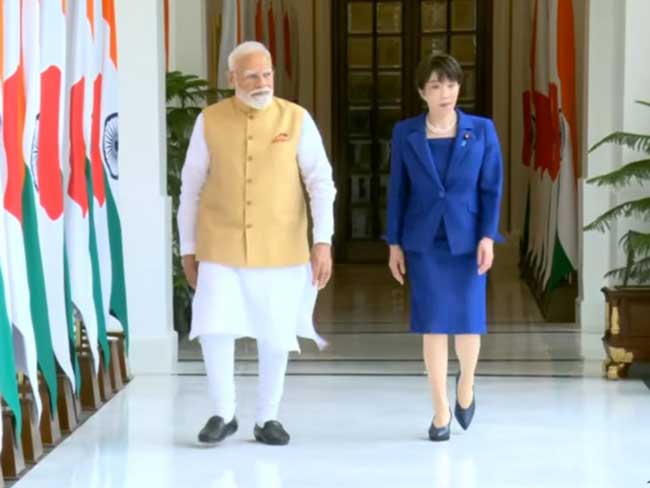
Prime Minister Narendra Modi’s reference to Japan’s Prime Minister Sanae Takaichi as his “little sister” has sparked widespread discussion in diplomatic and political circles. The remark is being seen not merely as a personal or symbolic gesture, but as a reflection of the deep strategic and emotional ties between India and Japan.
According to sources, during a bilateral meeting, PM Modi addressed Sanae Takaichi with warmth and affection, referring to her as his “little sister.” The Japanese Prime Minister reportedly responded positively, reaffirming the commitment of both nations to further strengthen bilateral relations.
Experts believe that such informal and emotionally expressive references in international diplomacy often signal trust, closeness, and long-term stability between countries. India and Japan already share a strong strategic partnership across defence, investment, technology, and global cooperation.


The context also carries a significant reference to former Japanese Prime Minister Shinzo Abe, under whose leadership India-Japan relations reached new heights. Shinzo Abe shared a close personal bond with PM Modi, which is widely regarded as a foundation for the current depth of bilateral ties.
Analysts suggest that the continued use of such emotional and familial language in diplomacy reflects the legacy of Shinzo Abe and highlights the continuity of strategic trust between India and Japan. It is being viewed as a symbolic reinforcement of the special relationship between the two nations.
Overall, the statement is seen as more than a personal remark—it reflects the long-term strategic partnership and mutual confidence shared between India and Japan.