
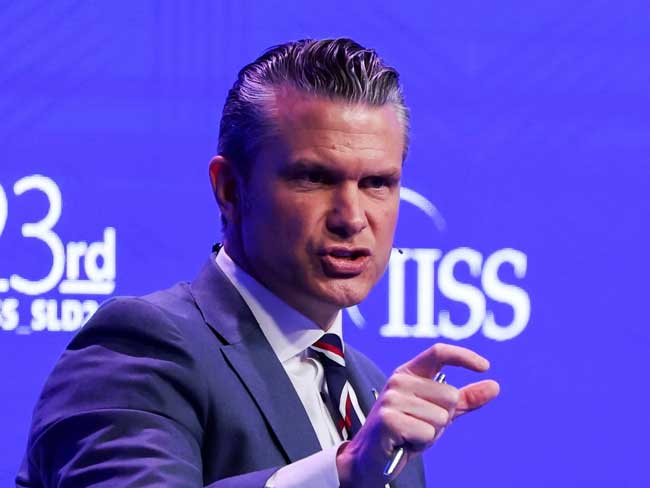
Singapore: Highlighting India’s growing strategic importance in the Indo-Pacific region, US Defense Secretary Pete Hegseth described India as a “critical anchor” for maintaining regional stability and balance of power during his address at the Shangri-La Dialogue 2026, Asia’s premier defense and security summit held in Singapore.
Speaking before defense officials, military leaders, and policymakers from across the world, Hegseth said that a strong and capable India plays a vital role in preserving peace and stability in South Asia and the broader Indo-Pacific region. He emphasized that India’s rise as a major security partner contributes significantly to maintaining a balanced regional order.
The US defense chief noted that Washington envisions an Indo-Pacific region where no single country dominates. Without directly naming China in several parts of his remarks, he stressed that regional security and prosperity should not be controlled by any one power and that a balance of power remains essential for long-term peace and stability.


Praising India’s military modernization efforts, Hegseth said the country is rapidly expanding its defense capabilities and strengthening its role as a security provider in the Indian Ocean region. He pointed to India’s growing industrial and logistical infrastructure, which supports advanced military operations and enhances regional security cooperation.
He also highlighted the deepening defense partnership between India and the United States. According to Hegseth, the two countries are advancing defense co-production initiatives, including efforts related to the Javelin anti-tank guided missile system. Such collaborations, he said, reflect the increasing trust and strategic alignment between New Delhi and Washington.
Addressing concerns about China’s military expansion, Hegseth stated that Beijing’s growing military capabilities and assertive regional posture have raised concerns among several countries in the Indo-Pacific. However, he clarified that the United States is not seeking direct confrontation with China and continues to maintain communication channels aimed at preventing conflict and reducing tensions.
The US defense secretary also urged America’s allies and partners in Asia to increase their defense spending and assume greater responsibility for their own security. He argued that collective security requires broader contributions from partner nations and that the burden of maintaining regional stability cannot rest solely on the United States.
Strategic analysts view Hegseth’s remarks as a strong signal of Washington’s continued commitment to strengthening ties with India amid rising geopolitical competition in the Indo-Pacific. With growing concerns over maritime security, regional influence, and military balance, India is increasingly being seen by the United States as one of its most important strategic partners in the region.
The remarks at the Shangri-La Dialogue are expected to further reinforce India-US defense cooperation and underline New Delhi’s expanding role in shaping the future security architecture of the Indo-Pacific.