
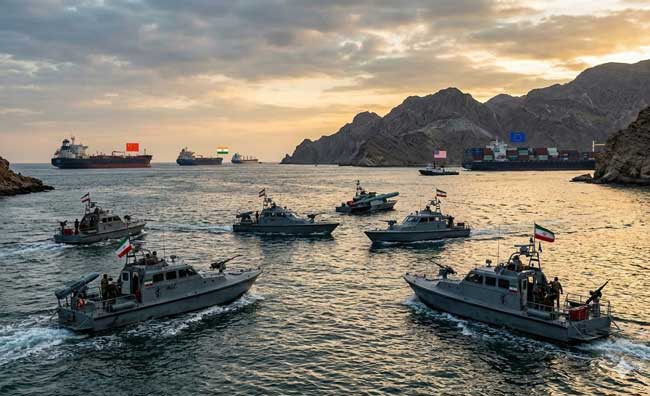
Tehran: The process of reopening the Strait of Hormuz, one of the world’s most critical maritime trade routes, has begun following the recent understanding between Iran and the United States. However, alongside the reopening, the Persian Gulf Strait Authority (PGSA) has introduced a new set of regulations governing the passage of commercial vessels through the strategic waterway.
Under the revised guidelines, all commercial ships intending to transit through the Strait of Hormuz must submit a transit request at least 48 hours in advance. Vessel operators will be required to provide details regarding their route, schedule, cargo, and safety arrangements before entering the passage. Authorities say the measure is aimed at improving maritime traffic management and enhancing navigational safety in the region.
Iran has also announced that, as part of the current arrangement, no security, environmental, or insurance-related fees will be charged to vessels using the Strait during a 60-day transition period. However, officials have indicated that new charges or regulatory fees could be introduced once this temporary period expires.


Despite the reopening, maritime experts caution that normal shipping operations may not resume immediately. Concerns remain over regional security conditions and the need to address potential navigational hazards created during recent tensions in the Gulf. Several international shipping companies are reportedly adopting a cautious approach and closely monitoring developments before fully restoring regular traffic through the route.
The Strait of Hormuz is regarded as one of the most strategically important waterways in the world. Approximately one-fifth of global oil supplies and a significant share of liquefied natural gas (LNG) exports pass through the narrow passage connecting the Persian Gulf to international waters. Any disruption in the Strait has a direct impact on global energy markets and shipping costs.
Recent geopolitical tensions had severely affected maritime traffic in the region, raising concerns among energy-importing nations and contributing to volatility in international oil prices. The gradual reopening of the route is therefore being viewed as a positive development for global trade and energy security.
While some vessels have already resumed transit, governments, energy companies, and shipping operators around the world are closely watching how quickly normal operations can be restored. Countries heavily dependent on Gulf energy supplies, including India, are expected to benefit from a stable and uninterrupted flow of cargo through the Strait of Hormuz in the coming weeks.