
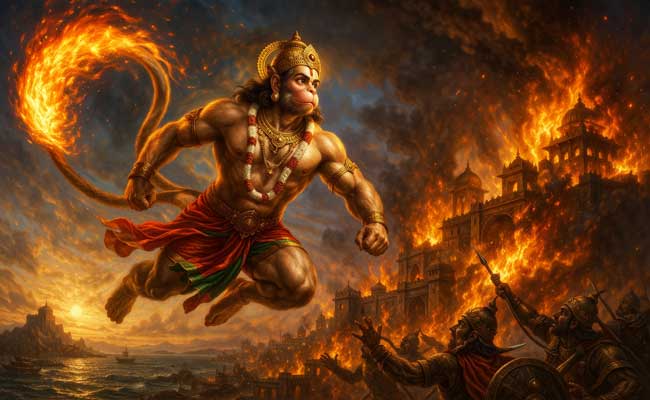
Today, on 2nd April 2026, devotees across India celebrate the sacred festival of Hanuman Jayanti. On this day,  special prayers and rituals are performed to honor Lord Hanuman. He is not only a mighty warrior but also the master of the eight supernatural powers (Ashta Siddhis) and the nine treasures (Nav Nidhis). His divinity and strength have many dimensions, the mysteries of which inspire devotion and awe among his followers.
Divinity Embedded in His Tail
Ancient scriptures narrate numerous extraordinary incidents related to Hanuman’s tail. In the Ramayana, it is mentioned that whenever any demon attempted to seize his tail, they invariably failed. His tail possessed such immense power that it could not be controlled by ordinary means. The most famous instance of this power is the burning of Lanka, when Hanuman set the city ablaze using his tail.
The Rudra Avatar of Lord Shiva
According to spiritual beliefs, Hanuman is the Rudra avatar of Lord Shiva. His tail embodies the radiance of Shiva and also symbolizes Kundalini energy—a spiritual force that elevates one to higher levels of consciousness.


A Tail of Immense Power
Hanuman’s tail was not only a symbol of power but also of control and protection. The Shiva Purana mentions that Lord Shiva’s blessings constantly resided in it. During the burning of Lanka, Hanuman extended and contracted his tail at will, confounding the demons and demonstrating the extent of his strength. At ordinary times, the tail appeared calm and ordinary, but in moments of need, it became a source of devastating power.
The Residence of Mother Parvati
A sacred legend narrates that Ravana once demanded a palace from Lord Shiva, originally built for Mother Parvati. To pacify her anger, Lord Shiva promised that in the Treta Yuga, Hanuman would incarnate, and Mother Parvati’s essence would reside in his tail. Through this divine energy, Hanuman carried out the burning of Lanka, symbolically calming Parvati’s wrath. This is why Hanuman’s tail is believed to house the divinity of Mother Parvati.
Spiritual Significance of the Tail
Hanuman’s tail is not merely a symbol of power and destruction but also of accomplishment, protection, and spiritual fulfillment. Even today, devotees circumambulate his tail, regarding it as a source of strength, divine energy, and safeguarding in their lives.
Disclaimer: The stories and beliefs presented here are based on religious and scriptural traditions. For precise and in-depth understanding, consultation with scholars or experts in the field is recommended.