

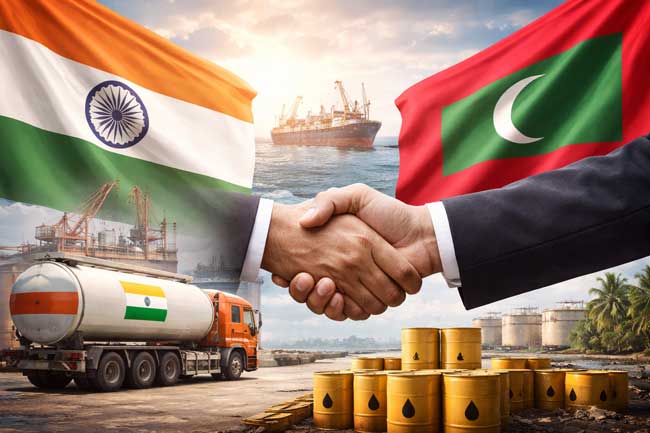
In geopolitics, rhetoric is often loud—but reality is louder. And today, the Maldives stands as a telling example of how quickly political posturing can collapse when confronted with hard economic truths.
Not long ago, the streets and political discourse in Maldives echoed with the “India Out” campaign—an aggressive push that sought to distance Male from India, questioning its role and presence in the island nation. The message was clear: sovereignty over strategic partnership, emotion over pragmatism.
But crises have a way of exposing the fragility of such narratives.


Today, the same Maldives has turned to India—this time not with slogans, but with a request. A request for oil. A request born out of necessity, not choice.
The ongoing turmoil in West Asia has choked vital energy supply routes, sending shockwaves across import-dependent economies. For a nation like the Maldives, which relies almost entirely on external fuel supplies, the impact has been immediate and severe. Tourism-dependent, geographically isolated, and logistically vulnerable—the country has found itself staring at an energy crunch it cannot solve alone.
And so, the pivot.
What makes this development particularly striking is not just the request for fuel—but who it has been made to. India, the very country that was politically targeted not long ago, is now being seen as the most reliable partner in a moment of crisis.
This is not irony—it is geopolitics at work.
India, with its vast refining capacity and strategic reserves, has steadily positioned itself as a regional stabiliser. From Sri Lanka during its economic collapse to Bangladesh amid supply disruptions, New Delhi has repeatedly stepped in where global systems have faltered. The Maldives’ outreach only reinforces this emerging reality: in South Asia, when systems fail, India becomes the fallback.
But this moment also raises uncomfortable questions for Male.
Was the “India Out” campaign ever rooted in strategic thinking? Or was it a short-sighted political tool that ignored ground realities? Because today, the same geography that was once used to argue for distancing from India is forcing a return to it.
Proximity, after all, is not just a map—it is a lifeline.
For India, the situation demands both maturity and clarity. Assistance, if extended, must be guided by long-term strategic interests rather than short-term optics. Humanitarian support and regional stability are important—but so is ensuring that partnerships are built on consistency, not convenience.
Because if diplomacy is to mean anything, it cannot swing with every crisis.
The Maldives’ request is more than an energy transaction—it is a lesson. A lesson in how quickly narratives can shift when survival is at stake. A reminder that in geopolitics, alliances are not sustained by slogans, but by trust, reliability, and realism.
And above all, it is a quiet acknowledgment of a simple truth:
You can oppose geography in speeches—but you cannot escape it in crisis.