
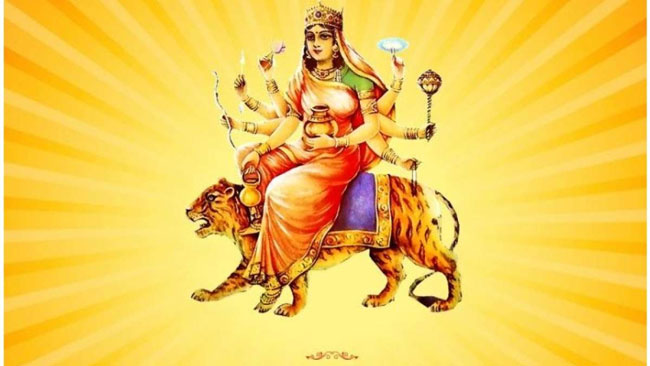
 When creation had no form, when there was nothing but darkness and an endless void, a divine smile gave birth to the universe—that smile was of Goddess Kushmanda. Worshipped on the fourth day of Navratri, she is not merely an object of devotion, but the very embodiment of the primal consciousness that gave meaning to existence.
The name ‘Kushmanda’ itself holds profound significance—‘Ku’ means small, ‘Ushma’ means energy or warmth, and ‘Anda’ means cosmic egg or universe. Together, it represents the divine power that created the vast cosmos from a subtle, minute energy. This is not just mythology, but a spiritual indication that all creation originates from the subtlest form of energy.
Goddess Kushmanda is depicted with eight arms, holding various weapons and a pot of nectar. This form is not just a display of power, but a reflection of her control over the many dimensions of life. The pot filled with nectar symbolizes life-giving energy, while the weapons signify that creation must always be accompanied by protection and balance.


It is believed that she resides within the core of the Sun. This symbolism is deeply meaningful. The Sun, the ultimate source of energy, reflects her as the origin of all life forces. It teaches us that the true source of energy does not lie outside, but within ourselves.
In today’s world, where human life is burdened with stress, fear, and uncertainty, the form of Goddess Kushmanda offers profound inspiration. Her smile teaches us that creation is not merely a result of external circumstances, but of inner harmony and positivity. Where there is inner light, there is the possibility of creation.
Worshipping Goddess Kushmanda is not just a ritual, but a journey of awakening the dormant energy within the soul. It reminds us that every individual carries a creative force, which, when guided properly, can transform life in meaningful ways.
Thus, Goddess Kushmanda is not just a deity, but a symbol of infinite energy, creation, and the deeper mystery of life that exists in every particle of the universe. Her worship inspires us to look beyond the external world and discover the cosmos within—a cosmos that began with a divine smile.