

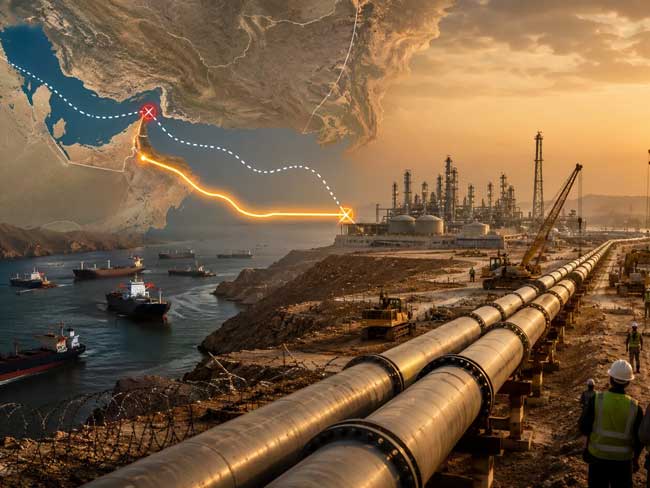
Global energy geopolitics has always been shaped as much by geography as by resources. Few places illustrate this better than the Strait of Hormuz—a narrow maritime corridor through which a significant share of the world’s oil supply flows. It is not merely a shipping lane; it is a strategic pressure point that can influence economies far beyond the Gulf region. Against this backdrop, the United Arab Emirates’ decision to accelerate its new oil pipeline project is more than an infrastructure upgrade—it is a statement of strategic intent.
At its core, the move reflects a shifting understanding of vulnerability. In an era marked by regional tensions, intermittent conflicts, and unpredictable disruptions, dependence on a single maritime chokepoint has become an unacceptable risk for major energy exporters. By fast-tracking a pipeline that bypasses Hormuz, the UAE is effectively working to insulate a portion of its oil exports from geopolitical volatility.
This is not just about engineering efficiency. It is about energy sovereignty. The pipeline represents an effort to reroute critical supply chains away from contested waters and into controlled, land-based infrastructure. In doing so, the UAE is reducing exposure to external shocks while strengthening its long-term export reliability.


However, this development also signals a broader transformation in global energy strategy. Countries in the Gulf are no longer relying solely on traditional sea routes. Instead, they are investing in diversification—of routes, infrastructure, and risk. If successful, such projects could gradually reduce the strategic centrality of chokepoints like Hormuz, even if they do not eliminate their importance entirely.
Still, it would be simplistic to assume that pipelines can neutralize geopolitical risk altogether. They may reduce maritime vulnerability, but they also shift the terrain of competition. Energy politics does not disappear; it adapts. The struggle over influence simply moves from sea lanes to infrastructure networks, transit corridors, and regional alignments.
The Strait of Hormuz remains critical today, handling a substantial portion of global oil flows. Yet the UAE’s initiative reflects a future-oriented mindset: one in which energy security is not defined by production alone, but by the resilience of supply chains. The ability to maintain exports under pressure is becoming as important as the ability to produce them.
In this sense, the UAE pipeline project is part of a larger global trend. Energy systems are gradually moving from centralized dependencies toward diversified and redundant networks. Nations that can build multiple pathways for their exports will hold greater strategic leverage in an increasingly uncertain world.
Ultimately, this is not merely a story about oil infrastructure. It is about how global power is being reorganized around control, redundancy, and resilience. The Strait of Hormuz has not lost its significance—but its monopoly over energy flow is slowly being challenged.
And that may be the most important shift of all: the world is no longer just competing over energy resources, but over the routes through which those resources travel.