

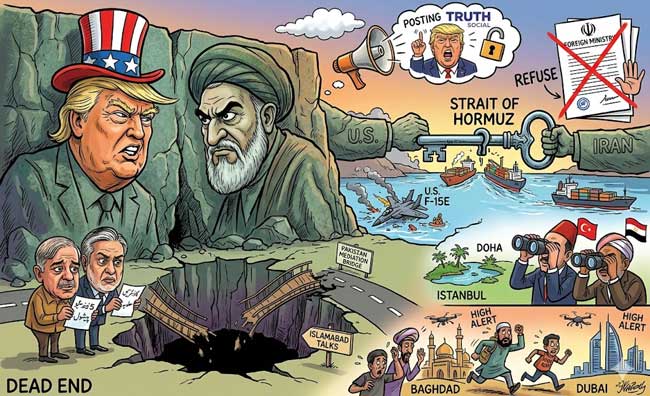
Pakistan’s attempt to mediate a ceasefire between the United States and Iran has collapsed, with talks now effectively reaching a dead end. According to a report by The Wall Street Journal, citing mediators, Iran has firmly rejected the current diplomatic framework and refused to engage in proposed discussions with U.S. officials in Islamabad.
Tehran has conveyed a clear message to all mediating countries, including Pakistan, that it will not send representatives for talks and considers Washington’s demands entirely unacceptable. The breakdown highlights the widening gap between the two sides, making any immediate breakthrough unlikely.
Iran Sticks to Tough Conditions
Sources say Iran has reiterated its core conditions for ending the conflict. It has demanded war reparations from the United States, a complete withdrawal of American forces from the Middle East, and firm guarantees against any future military action. With Washington unwilling to concede on these points, negotiations have stalled.


Iran’s refusal to attend talks in Islamabad has effectively shut down the current channel of diplomacy.
Pakistan’s Mediation Effort Falters
Over recent weeks, Pakistan had been quietly attempting backchannel diplomacy to bring Washington and Tehran to the negotiating table. Prime Minister Shehbaz Sharif and Foreign Minister Ishaq Dar had publicly offered to host what they described as “meaningful and decisive” talks in Islamabad.
As part of this effort, Pakistan reportedly delivered a 15-point ceasefire proposal from the United States to Iran. Earlier, China and Pakistan had also jointly floated a five-point peace plan. However, persistent military activity and Washington’s hardline strategic demands appear to have derailed these efforts.
Analysts note that deep-rooted mistrust between the U.S. and Iran made Pakistan’s role as a mediator inherently difficult.
Escalation on the Ground
Tensions escalated further after Iran claimed it had shot down a U.S. F-15E fighter jet in its airspace. Western media reports indicate that one pilot was rescued by U.S. special forces, while search operations for another are still underway.
Turkey and Egypt Step In
With the Islamabad channel no longer viable, Turkey and Egypt are now exploring alternative venues to revive ceasefire negotiations. Doha and Istanbul have emerged as possible locations for future talks.
Strait of Hormuz at the Center
According to an Axios report, one of the key sticking points in the negotiations has been the Strait of Hormuz. A potential understanding was being explored under which Iran would reopen the critical maritime route for global trade in exchange for a ceasefire.
Trump’s Hardline Warning
The report also notes that U.S. President Donald Trump discussed the issue with Saudi Crown Prince Mohammed bin Salman during a phone call. Shortly after, Trump claimed on his social media platform, Truth Social, that Iran was seeking a ceasefire.
However, he made it clear that any such move would depend on the Strait of Hormuz being fully “open and free.” He warned that until then, U.S. military operations would continue, signaling a tough stance from Washington.
Iran Pushes Back
Iran’s Foreign Ministry has strongly dismissed Trump’s claims as false and baseless. Meanwhile, the conflict appears to be spreading across the region. The U.S. Embassy in Baghdad has issued a high alert, urging American citizens to leave Iraq immediately amid fears of attacks by Iran-backed militias.
Reports of drone strikes have also emerged from across the region, from Bahrain to Dubai, indicating a widening arc of instability.