
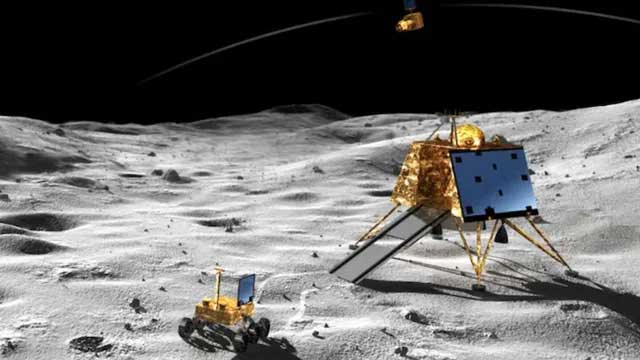
Desk : Data analysis from the Indian Space Research Organisation’s (ISRO) Chandrayaan-2 mission has revealed strong indications of water ice in permanently shadowed regions near the Moon’s south pole. The findings are being considered highly significant for future lunar exploration and possible human missions.
According to scientists from ISRO and the Physical Research Laboratory (PRL), Ahmedabad, the study suggests that ice may exist beneath the surface in craters that never receive sunlight. These areas, known as permanently shadowed regions, maintain extremely low temperatures, allowing ice to remain stable for long periods.
Study of Permanently Shadowed Craters
Researchers focused on craters located in the lunar south polar region where sunlight does not reach. Temperatures in these regions can drop to extremely low levels, making them ideal for preserving water ice.


The analysis was carried out using data from the Dual-Frequency Synthetic Aperture Radar (DFSAR) instrument onboard Chandrayaan-2. The radar observations showed patterns that are consistent with the possible presence of subsurface ice mixed with lunar soil.
Scientific Observations and Findings
Scientists observed unusual radar backscatter signals from certain craters, which differ from those reflected by normal rocky surfaces. These variations suggest the possible presence of water ice or ice-regolith mixtures beneath the lunar surface.
The study highlights that several deep craters in the south polar region—including areas such as Faustini, Haworth, and Shoemaker craters—are particularly promising candidates for ice deposits due to their permanent darkness and extremely low temperatures.
Importance for Future Space Missions
Experts believe that if confirmed through further missions, this discovery could be a landmark achievement in lunar science. Water ice on the Moon could serve as a vital resource for future astronauts, providing drinking water, oxygen, and even the possibility of producing rocket fuel.
Such resources would significantly reduce the cost and complexity of long-term lunar missions and could pave the way for establishing permanent human bases on the Moon.
A New Milestone for ISRO
The Chandrayaan-2 mission has already contributed significantly to understanding the Moon’s surface composition and geology. This new analysis further strengthens its scientific legacy.
The discovery enhances India’s position in global space research and marks another important step toward understanding the Moon’s hidden resources and future exploration possibilities.