

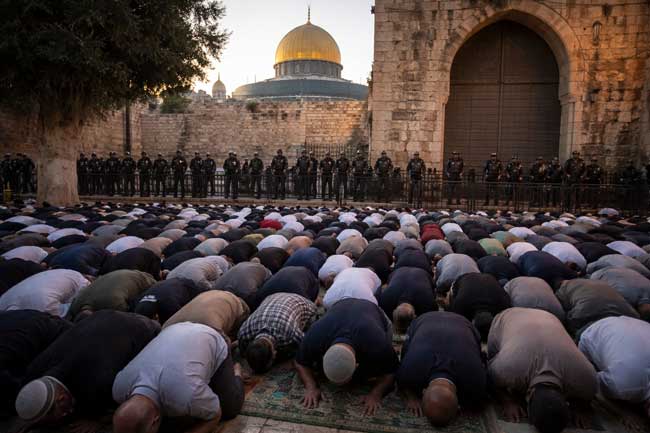
One of Islam’s holiest sites, the Al-Aqsa Mosque, has once again become the center of a deepening crisis. In an extraordinary and troubling development, Muslims were unable to offer prayers at the mosque even on Eid — a situation not seen in decades, leaving millions across the world distressed and disheartened.
On Friday, thousands of worshippers attempting to gather for prayers were stopped at the mosque’s gates. With no access granted, many were forced to pray at the Old City Gate of Jerusalem. The scenes were not only emotionally charged but also echoed the painful memories of 1967, when the mosque was completely shut during the war.
A Wound from History Reopened
During the 1967 war, Israel captured East Jerusalem and the Old City, leading to the closure of Al-Aqsa Mosque at the time. Nearly six decades later, history appears to be repeating itself — but in an even more volatile and globally sensitive environment.


Faith vs Security — The Core of the Conflict
Israel maintains that the closure is a necessary security measure amid ongoing war-like conditions. The mosque sits on a contested hilltop compound sacred to both Muslims and Jews, making it one of the most sensitive religious flashpoints in the world.
However, the move raises serious questions: how long can security concerns justify restricting religious freedom? With thousands of Muslims gathering every Friday for prayers, such restrictions strike at the very core of faith and rights.
Eid in Silence, Hearts in Pain
The holy month of Ramadan, usually marked by devotion and unity, has instead been overshadowed by grief and helplessness. Speaking to AFP, a man who has been praying at Al-Aqsa for over 60 years said emotionally:
“Al-Aqsa has been taken away from us… this has been the most painful Ramadan.”
His words reflect a broader anguish felt across the Muslim world. The ongoing situation in فلسطين (Palestine), combined with these restrictions, has intensified tensions across several Muslim-majority countries.
War Fallout and Rising Restrictions
Following Israel’s reported strike on Iran on February 28, authorities imposed stricter security measures, including a ban on gatherings of more than 50 people. Officials argue that crowded places could become targets of missile attacks.
Reports of missile debris near the Old City Gate have further heightened fear and uncertainty. Yet, the brunt of these restrictions has fallen most heavily on Muslim worshippers, who have been denied access to one of their most sacred spaces.
History Repeating, Risk of Escalation
In 1967, when the mosque was closed during Ramadan and Eid, worshippers had similarly gathered outside and prayed near the Old City Gate. That period also witnessed clashes between security forces and civilians.
Today, the situation once again stands at a fragile tipping point — where even a minor spark could escalate into wider unrest.
The locked gates of Al-Aqsa are not just barriers to a المسجد — they symbolize a deeper conflict over faith, rights, and justice.
The world now watches closely: will this silence give way to resolution, or spiral into further confrontation?