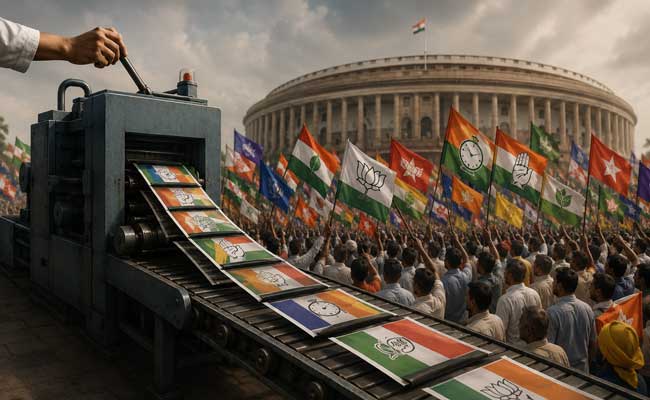
India’s political system is once again under scrutiny as fresh analysis highlights a striking trend: the steady rise of new political parties across the country. What was once seen as an occasional feature of democratic expression is increasingly being described as a kind of “factory” of political formations, where new parties emerge at frequent intervals, adding to an already crowded political arena.
At one level, this expansion can be interpreted as a natural extension of India’s democratic diversity. A vast and heterogeneous society like India inevitably produces multiple voices, aspirations, and identities seeking political representation. The proliferation of parties, in this sense, reflects the accessibility of democratic space and the constitutional freedom to organize politically.
However, the scale and nature of this growth raise important concerns. The increasing fragmentation of the political landscape suggests that Indian politics is becoming more dispersed, with smaller regional outfits and personality-driven platforms entering the arena alongside established national parties. This has made the electoral environment more complex, often leading to fractured mandates and unstable coalitions.
Political observers point out that many of these emerging parties are not necessarily rooted in coherent ideological frameworks. Instead, they are often driven by individual ambition, caste-based mobilization, or short-term electoral calculations. While such formations may succeed in capturing localized support, their long-term contribution to policy consistency and governance stability remains uncertain.
This trend is not unique to India, but its scale here is particularly noteworthy. In a democracy of over a billion people, political pluralism is expected. Yet when pluralism turns into excessive fragmentation, it raises questions about governance efficiency, policy continuity, and the ability of the system to translate popular mandates into decisive action.
Established national parties continue to remain the primary pillars of India’s electoral politics. However, the growing presence of smaller parties increasingly influences coalition dynamics and electoral outcomes. This has created a situation where political bargaining often becomes as significant as ideological positioning.
At the heart of the debate lies a fundamental tension: whether the rise of new parties is strengthening democracy by broadening representation, or weakening it by diluting political accountability and coherence. On one hand, it allows marginalized voices to enter the political mainstream. On the other, it risks turning elections into arithmetic exercises rather than contests of vision and policy.
India’s political evolution now stands at a critical juncture, where the richness of democratic expression must be carefully balanced with the need for functional governance.